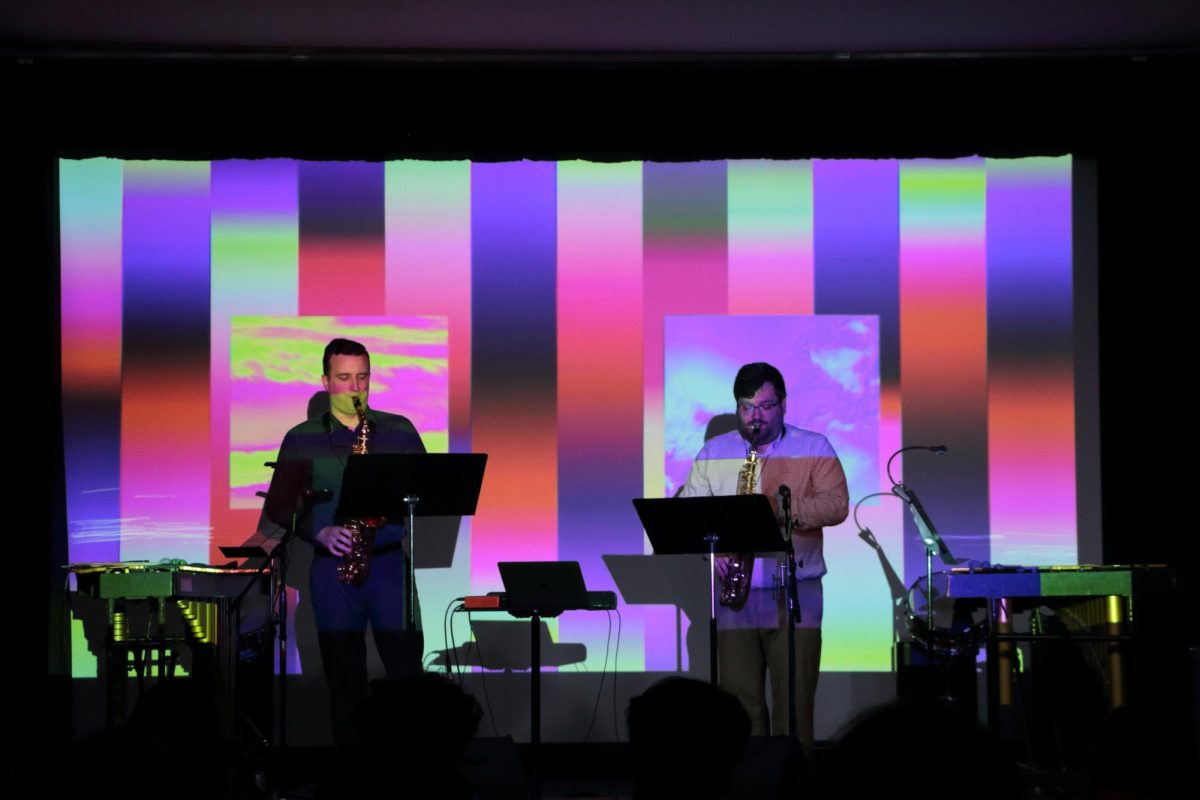
In Pontiac’s Little Art Theater, tucked away from the dusk’s downtown thrum, time seemed to slow. Richly varied frequencies cascaded from percussion instruments, woodwinds and brass to hang warmly in the air. Equally curious graphics and colorful, liminal imagery flickered and danced along the back wall, melding in step with the performers’ looming shadows.
This was the April 8 “Pulse + Pixels” interdisciplinary arts event, an intriguing concert that saw the intimate venue transformed into a multimedia canvas, merging electroacoustic and chamber music with visual art. The concert, directed by Oakland University music professor Justin Lamb, also marked the debut of the Oakland Artists Collective, a new initiative aimed at bridging artistic disciplines and expanding creative collaboration across metro Detroit.
“Essentially, it’s a modular group of students and faculty who have come together in this one event,” Lamb said. “Part of the mission of this project was to bring different disciplines together — In many ways, we are bringing together three disciplines: music, music technology, and art.”
Student visual artists August Wicker and Ava Guest created the majority of the visuals accompanying the musical performances through a request from OU graphic design professor Johnathan Cooper.
“The goal was to visit motifs like memory, loss, and nature to see if, after five minutes, we could transform your relationship with those ideas,” Cooper said.
The six performances cultivated a broadly apparent and close-knit dialogue between sound and image. Works by contemporary composers such as Christopher Cerrone and Eddie Farr unfolded in tandem with custom-designed projections. Each visual sequence was meticulously designed to respond to the emotional and thematic nature of the music.
Performances ranged from the reflective, percussion-driven “A Natural History of Vacant Lots” and dynamic, rhythmically urgent “Sympathy,” to the dueling saxophones of “Chatter-redux” and breezy, trumpet-accompanied narrative, “The Way Through The Woods.”
The inscrutable yet hypnotic “MonkeyWrench” merged audio and video in a manner both ominous and deeply immersive, while the breakneck live snare fills of “Deus Ex Metronome” defied any audience member’s preconceived notion of playing to mechanical beats as an inorganic or static ordeal.
Some performances stretched near the ten-minute mark, shifting and refracting, inviting the audience to engage with the art on multiple sensory levels. Each was met with raucous applause upon conclusion.
Halfway through the performance, Cooper brought Wicker and Guest onstage to acknowledge their contributions to the project, noting their distinctively uninhibited approach to the open-ended work.
“When I invited [Wicker and Guest] to participate in assisting me in this endeavor, I gave them no details — they just said, ‘yes.’” Cooper said. “The three of us would meet weekly and throw ideas at each other, come up with little animations and things.”
Cooper’s emphasis on experimentation gave the event a brimming sense of visual unpredictability and creative risk that suited the challenge of the performances.
“Normally, in the context of a design course or an art course, there is some semblance of objectivity,” Cooper said. “In this case, I said, ‘What if there was no context? What if this was abstract and exploratory, and gives us a chance to explore themes like memory or loss through music?’”
While the April 8 performance served as the collective’s inaugural project, organizers describe it as only the beginning. Future iterations may also incorporate additional disciplines such as dance or film, further expanding the possibilities of interdisciplinary collaboration in newly partnered performance spaces.
“I think it’s really important when creativity — exploring the space between performance and making art or music — can feel radical,” Cooper said.