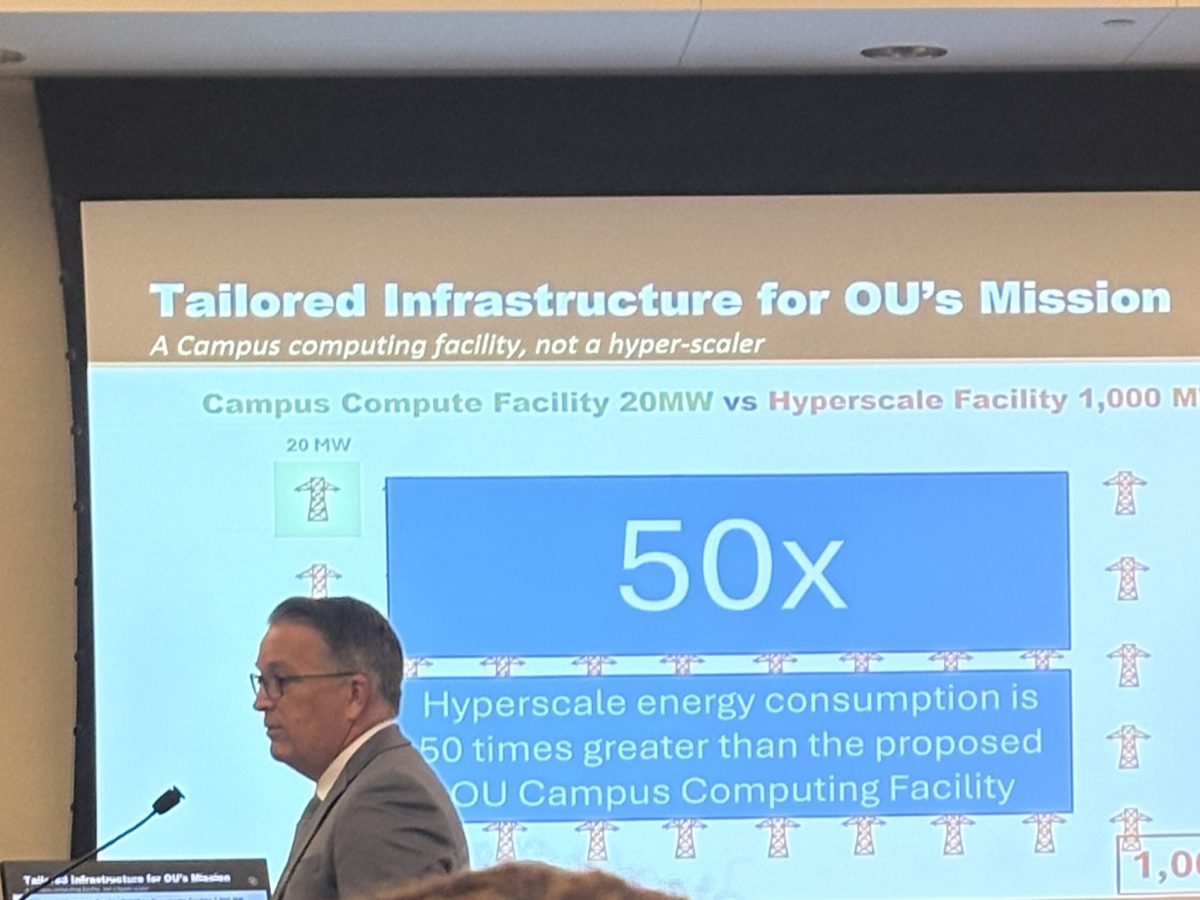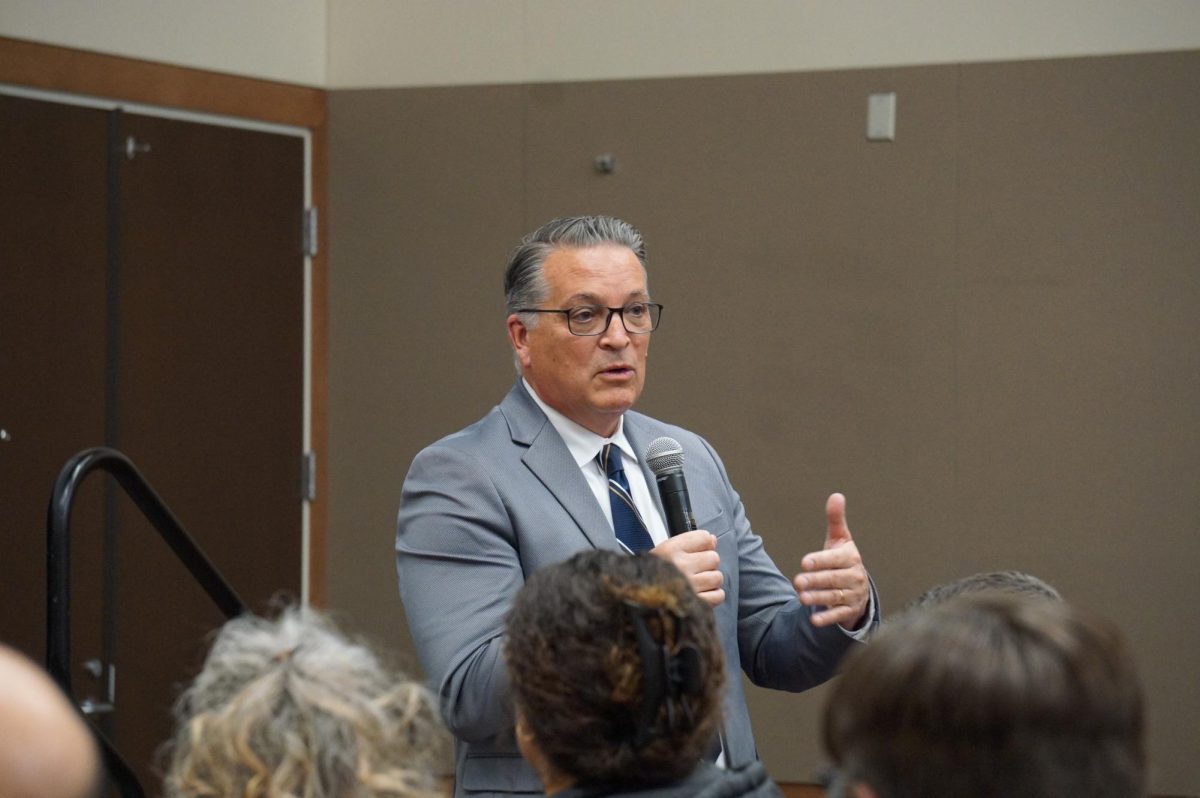
On March 26, Oakland University administrators outlined early-stage plans for the proposed on-campus AI institute and data center development effort during a campus town hall meeting in the Oakland Center Founders Ballroom. The well-attended meeting, hosted by Senior Vice President for Finance and Administration Stephen W. Mackey, consisted of a presentation and an extended question-and-answer segment open to students, faculty and community members.
The meeting aimed to clarify the scope of the project and address concerns surrounding its development specifications and purpose.
“Our data center is not an AI data center,” Mackey said. “We are building an enterprise data center that is going to have its own location with for-profit companies. We are building a data center for our high-compute needs… It’s very different in size, magnitude and environmental impact, and we are a long way from having a shovel in the ground.”
Mackey emphasized the benefit of the new data center as a singular education environment encompassing research partnerships, internships and employment opportunities for students. He also pointed to the necessity of relocating existing data centers on campus into a specifically-designed space equipped for high-powered computing.
“Our current infrastructure is housed in super inefficient spaces,” Mackey said. “The world is getting faster… and we are not keeping up. We are getting passed by without modern data center equipment.”
The proposed data center would be developed through a public-private partnership (P3) agreement with Fairmount Properties, an Ohio-based real estate development firm with experience in higher education and innovation districts.
“There will be no construction cost to OU,” Mackey said. “Our agreement is that they bear the finances and they build the data center.”
Mackey said the administration is seeking faculty input on potential partnerships with tenant companies to operate in the data center. The university would retain final approval over all tenants, selecting companies based on their willingness to collaborate through internships, scholarships, research financing or similar opportunities.
Through May, the project will remain in the initial feasibility phase, with no final decisions made regarding design or construction. Mackey identified key steps in the feasibility phase, including obtaining certifications from the power provider — DTE Energy — and the Internet service provider, as well as assessing specific computational needs and financial viability.
“It’s really to identify a purpose-built facility that’s going to drive our campus innovation forward,” Mackey said. “That’s happening in the feasibility study — and we could decide that this is unfeasible, and we would not move forward.”
If the project moves forward, it will be presented to the OU Board of Trustees in June, leading into the pre-development “due diligence” phase later this summer. Through fall 2027, the administration will evaluate the conditions of development and undertake environmental studies through shared governance. Mackey stressed that finalization is still not assured at this point.
The next phase — design — would involve technical evaluation and building layout decisions. Mackey explained that this phase will provide many of the certainties necessary to engage community members with answers to lingering questions.
The final development phase would oversee construction throughout an approximate 18-month period. The administration is currently reevaluating the P-35 parking lot as a potential development site and taking other options into account.
“Again, at the end of design, if we can’t build it or it won’t work, there’s an exit ramp for us and Fairmount to exercise, should it not be viable to move forward,” Mackey said. “We’re about three years out from having a project — minimum, three years.”
Concerns raised during the town hall largely centered on environmental impacts and sustainability goals. One student asked about the precedent OU could be contributing to by moving ahead with construction of another data center in the Great Lakes region, noting concern for freshwater resource consumption.
Mackey highlighted tax incentives and statutes posed by the state government against the drilling of new wells, indicating that water for cooling must be sourced from the local municipality. He also drew a parallel to recent, ruinous cases of excessive water consumption from data centers in Nevada, precluding similar situations on campus due to both Michigan’s state statutes and OU’s values as an institution.
“We are committed to exploring the most efficient cooling systems that we can use based on the design of the center and the type of compute that is going to be in there.” Mackey said. “We are also, as an institution, committed to protecting our resources, and that means that these questions have to be answered before we put a shovel in the ground.”
Another student levied concerns about the facility causing further strain on campus utilities following this winter’s high temperature hot water pipe leaks. Mackey stated that the new facility would relieve the worn infrastructure by diverting excess heat to ideal locations.
“Our plan is to take [the Mathematics and Science Center] and heat and cool that building with the heat offtake off of the data center, which will reduce the consumption coming out of the central heating plant and reduce the pressure and the temperatures coming out of that system,” Mackey said. “So that would actually help reduce that risk.”
Students also questioned the differentiation between the AI institute and the facility itself.
“An institute is a cluster of thought leaders — it is not a machine,” Mackey said. “The institute is not what we are building. [It] is a byproduct of the facility.”
Should the university choose not to follow through with the project, the issue of OU’s outdated current infrastructure will still need to be addressed.
Mackey explained that while resolving current infrastructural concerns with the new partnered facility — which will draw on a previously unused 26 megawatt surplus from a DTE substation on campus — is the most cost-effective solution, the most likely fallback would be to issue debt to cover independent construction fees, which would be paid from tuition.
“With a P3 opportunity, what you’re doing is you’re using what we call ‘other people’s money’… and so they carry the capital stack, but they also generate the revenue to pay for it,” Mackey said. “To upgrade our current infrastructure into a modern data center would probably take a bond issuance of 10s of millions of dollars, and then that would have to be covered off of general fund revenue.”
Mackey said that as pre-development continues, so will community engagement efforts. He emphasized the importance of students attending OUSC meetings and encouraged interested parties to follow updates through the project’s website, which includes a regularly updated FAQ and timeline. One may also fill out the forum or write to [email protected].
“As I have said all along, we share the information as we get it,” Mackey said. “We are going to continue these conversations — you have my full commitment to that.”
“If we find that the project isn’t right for us, we will not move forward.”