“Going for a PR?” the lady in line behind me asked.
It was six hours into my flight to Tokyo, and I was stuck waiting for the bathroom under the dim blue lights of the cabin.
“What do you mean?” I asked, blinking at her.
“For the marathon,” she said, as if it were the most obvious thing in the world.
That’s when everything clicked: I would be in Tokyo during the Tokyo marathon. My flight was just two days before the race.
Suddenly, a lot of things started making sense: the absurd number of people stretching in the aisles, lunging in the galley and squatting near the emergency exit. Everyone in the economy section looked young and fit.
I smiled and took the compliment. There are worse things to be mistaken for than a marathon runner. I was flattered and told her I ran the occasional holiday Turkey Trot. I declined to give her my 5K time.
Universal girlhood
On my second day in Tokyo, I met with a Japanese delegation of women: a group of 10 young Japanese women, all either in university or young professionals.
To be honest, Tokyo was confusing. I was overwhelmed. I didn’t speak Japanese. I was insanely jetlagged. We were supposed to talk for an hour over tea. What would we even talk about?
Apparently a lot. I asked the girl next to me what she liked doing for fun.
“Going to cute coffee places with friends, watching movies and baseball,” she said.
I smiled because I love all three of those things too.
“Oh my gosh, Shohei Ohtani is so hot!” another girl added.
We all giggled and scooted our chairs closer to each other. I found myself grinning and nodding along. It felt like I was having a conversation with my friends back home.
One of the girls was traveling to D.C. in a few weeks. I sent her my Google Maps recommendations – a few brunch spots, dinner places, the works. I gave her tips on buying a Metro Pass and told her the best neighborhoods I think she would like to visit.
I then asked her about shopping, because I was on the lookout for good – not too tacky – Shohei gear. That night, I got an Instagram DM from her with a pinned location.
“This is where I get all my jerseys from. Enjoy Japan!”
Even thousands of miles from home, I found comfort in something simple: girlhood. You can cross an ocean and still find someone who fangirls over the same baseball player and understands your coffee obsession. Somehow, that made Tokyo feel just a little smaller – and a lot more like home.
Walking in Tokyo alone
After a long twelve-hour day in Tokyo, our group split up. The last stop of the day was Don Quixote, but I had already been there once and honestly didn’t have anything more to buy.
“I can figure it out,” I told them with a shrug and smile.
I mapped my route on Google Maps and headed to the metro station alone. Tokyo’s metro is not only one of the transportation systems in Japan but in the entire world. Nonetheless, I took a deep breath and descended the steps.
There’s something quietly empowering about navigating public transportation in a foreign country. Every correct transfer feels like a small victory. You feel like a local. After two successful transfers, I stepped out of the station with pride.
If I can figure out the Tokyo metro – alone, jetlagged and confused – I thought, I can do anything.
On the walk back to the hotel, I stopped at 7-Eleven for ice cream. I have a fierce passion for a specific brand, Choco Monaka Jumbo, which can’t be found in the U.S. I bought two.
The streets were quiet. It was late, and I was alone. I felt completely safe.
This may feel like a small detail, but it isn’t. I’ve been in places alone where I’ve felt uneasy. In Paris, catcalling could get bad. Even in Detroit, I walk extra fast to my parking deck after work. But in Japan, I wasn’t rushing or holding onto my purse. I was simply walking.
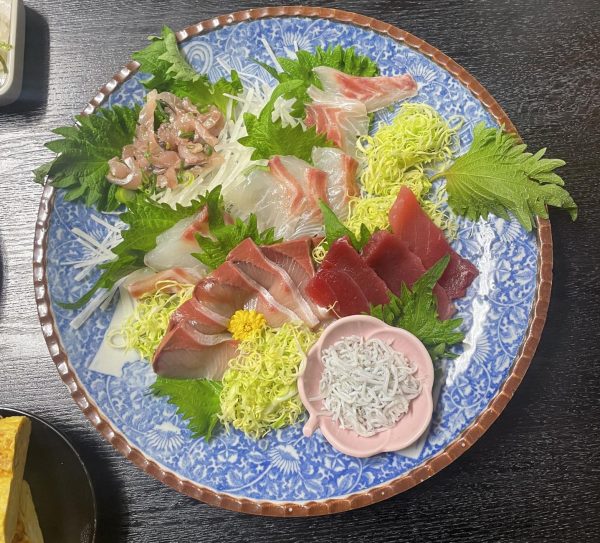
That night, I met my friends for dinner at a sushi restaurant and ordered a draft beer and an enormous sushi dinner. Everything felt perfect in that moment: successfully navigating the metro alone, indulging in my favorite ice cream and sharing a nice dinner with friends. I felt incredibly lucky.
Working on a wasabi farm
After a whirlwind, and honestly quite exhausting, few days in Tokyo, I escaped to rural Japan to work and stay in the countryside on a wasabi farm near Mt. Fuji, in a city called Gotemba.
I slept on wooden mats on the floor and stayed with an older couple who spoke no English. Luckily, I was there with my friend Madeliene, which made the whole experience infinitely more fun and slightly less terrifying.
Each day, I donned rain boots, put on my Shohei Ohtani baseball cap and harvested fresh fruit and vegetables. There was mud everywhere, but the air was impossibly clean, and somehow it made every squishy step worth it.
Without exaggeration, it was the best food I’ve ever eaten. The host made homemade sake in his garage, which I seriously considered buying and bringing home to pop for my graduation, but my luggage had other plans.
For breakfast, I ate yogurt drizzled with fresh honey straight from his bees. One night, we sat on plastic chairs in his garage, feasting on vegetables slow-roasted in foil over a fire. No seasoning needed. Every meal was a full-on farm-to-table experience.
One afternoon, a reporter showed up. I think he was confused and curious about what two American girls were doing in the middle of rural Japan, digging up wasabi. We smiled and posed with our harvests.
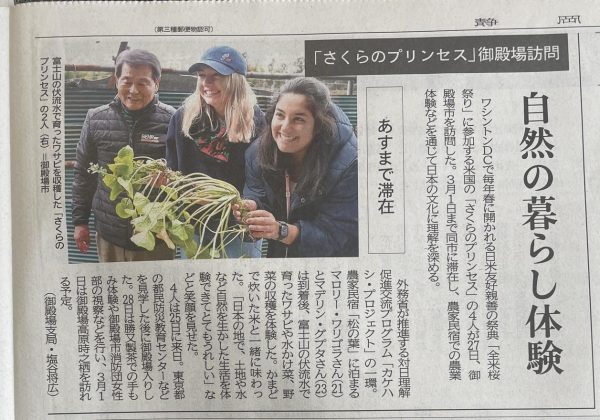
The next morning, while eating my honey and yogurt breakfast and drinking my green tea, our host handed us a newspaper.
There we were – on page 14 – grinning like fools, each of us holding up a chunk of wasabi we had just pulled from the ground. I took a copy home, and to this day, it remains one of the coolest souvenirs I’ve ever had.
“What if we die?”
Madeline and I showered and got ready for bed. We were staying in the guest house, which meant we had to walk in clogs to the main house to shower.
The walk from the guest house to the main house was scary at night. On the walk back to the guest house, I sprinted in my hoodie with wet hair to minimize outdoor exposure. I silently prepared myself as an attacker.
The farmland felt eerily quiet after dark – acres of open land, only a handful of people in the village. I shut off my phone and put my head down.
“Mallory?” Madeline whispered.
“Yeah?” I replied, turning to face her.
“What if they kill us tonight and this is just a trap?”
My stomach dropped, and I squealed.
“Think about it,” she continued. “Acres of land. No one is really nearby. We’re in the middle of nowhere.”
I thought about it. Just five minutes away was the ancient shrine where we had prayed that morning. We were surrounded by centuries of tradition, but also centuries of spirits. It felt like the opening to an A24 horror movie.
By the morning, of course, nothing had happened. The sweet elderly couple woke us up with fluffy pancakes. I took a warm bite of my pancake and smiled.
Legends and prayers
I was staying near Mt. Fuji during a particularly foggy stretch of time, which meant the mountain was rarely visible. Day after day, I surveyed the landscape and was repeatedly disappointed by the clouds blocking the view. By the end of my time in Gotemba, I had accepted the fact that I wasn’t going to get an Instagram-perfect photo.
Then someone told me something strange.
“Oh, but this is excellent news, you haven’t gotten a good view.”
I scrunched my eyebrows and frowned. Of course I wanted to see Mt Fuji.
“Legend says Mt. Fuji hides her beauty from beautiful women when they’re nearby,” they explained. “She gets jealous and doesn’t want them to see, so she hides the view.”
What an honor it was to have Mt. Fuji consider me beautiful. I smiled. If I wasn’t going to get a perfect view, at least I had thousands of years of Japanese legend backing my looks. I decided to take the compliment.
It was my last day in Gotemba, and to celebrate, our hosts prepared a farewell lunch. The older couple I had been staying with whispered something to the translator.
“They said they would like to go to the local shrine to pray for your future.”
So we set off together, walking about 15 minutes down a narrow road to the local shrine. It wasn’t glamorous or ornate, but it had the peaceful, weathered charm that places like this always seem to have.
They handed me a small wooden block and explained that I could write a wish and hang it on the rope between the trees. I wrote down my wish for good fortune, new adventures and the chance to return to Japan one day.
Then I stepped back and watched as the old man and woman bowed, tossed a coin into the offering box and clasped their hands together in prayer.
Maybe it’s just the placebo effect, but knowing that an elderly couple I had only just met was praying for my future made me feel strangely hopeful.
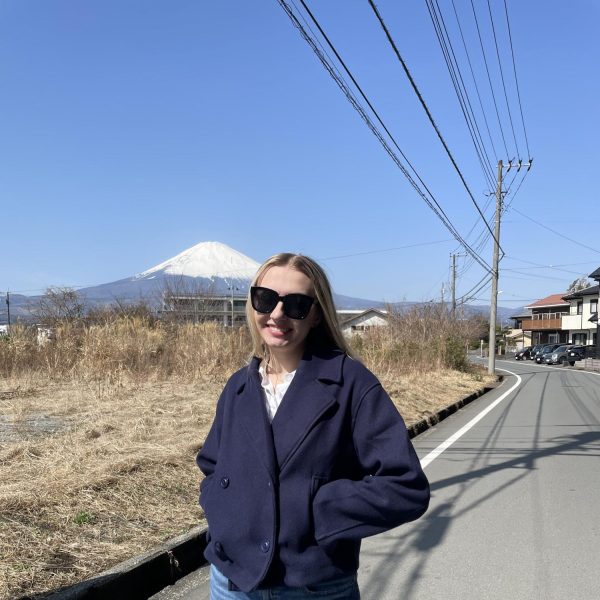
On our walk back to lunch, the clouds finally cleared, and Mt. Fuji appeared. For a moment, I held my breath – fog rolling back like a curtain and sunlight hitting the peak just right. Just hours before leaving, the mountain decided to show herself, as if giving me a private, last-minute hello.
I quickly snapped a few photos, grinning like an absolute tourist, thrilled that I finally got to meet Mt. Fuji face-to-face. I forgave her for hiding all this time – all I wanted was a quick visit.
“Do you think I woke up ugly today?” I asked, slightly offended.
A few days later, on my ride to Haneda airport, it started raining. It felt serendipitous: I had made it through the entire trip without rain, which felt like a miracle considering I was visiting in March, when the weather is usually damp and unforgiving.
“It’s a good sign it’s raining,” the guide said. “In Japan, people see it as a kind of rebirth. The earth needed it.”
Somehow, that felt like a good way to leave Japan – with a minor ego boost from Mt. Fuji, an elderly farm couple praying for my future and a symbolic rebirth to send me on my way.