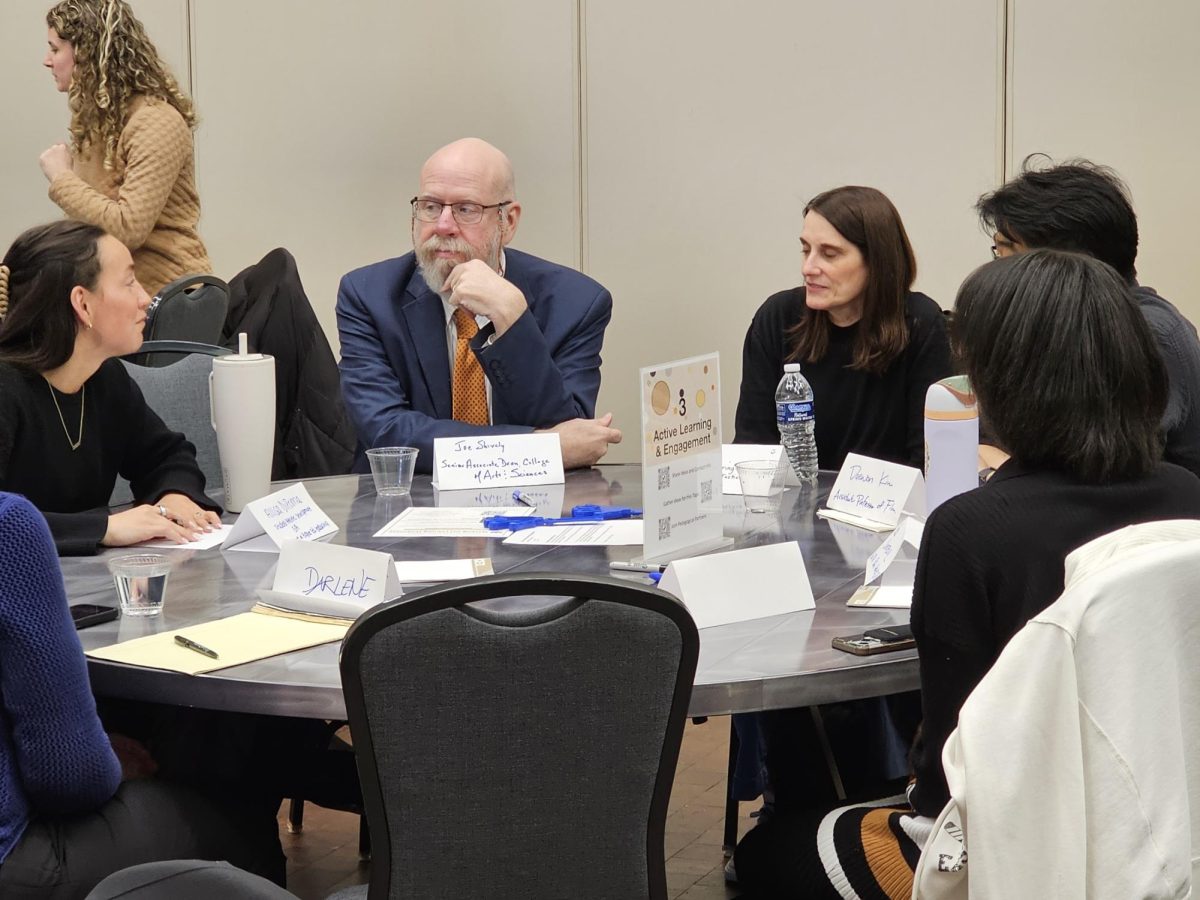
On March 19, Students and faculty at Oakland University gathered in the Founders Ballroom for a new kind of close and reflective conversation about learning through small-group dialogue at the Center for Excellence in Teaching and Learning’s “Students as Partners: Student–Faculty Roundtables on What Works.”
The annual event, organized in collaboration with OU Student Congress, brought students and educators together for rotating discussions on topics ranging from inclusive teaching practices to artificial intelligence in the classroom. More than ever across the event’s three previous years of operation in different forms, the new roundtable format emphasized face-to-face conversation, allowing more voices to be heard and heeded.
“The students have inspired this event,” Christina Moore, associate director of the Center for Excellence in Teaching and Learning, said. “This is actually our first time doing this particular event, because it used to be a panel event, which has been great, but we wanted more student involvement and more back and forth,” Moore said.
Moore said the idea for the event has been in development for several years, but this is the first time it has taken the form of interactive roundtables rather than a panel.
“There are really only a few ways that faculty can get input from students,” Moore said. “It’s normally the students in their own classroom, while they’re in the class.”
The shift in format aimed to address a common challenge in higher education: how faculty gather meaningful student feedback. Moore said that while traditional methods such as course evaluations can be helpful for collecting general feedback, they often fall short of capturing the full range of student experiences.
“Not all students are alike, and students can have totally different ideas on what works for them,” Moore said. “We have to keep talking to students and ideally work together on solutions.”
Throughout the event, participants rotated through several discussion rounds, each guided by student facilitators. The roughly 40 participants used the opportunity to hash out any potential concerns in a civil, structured manner and, in turn, consider suggestions from the other parties.
“It’s not them versus us… we all care about the same things,” Moore said. “It’s really just about sharing perspective, understanding, and ideas that people may have.”
Each table also included a transcriptionist compiling key takeaways into a shared document. Moore said the collected insights will guide future faculty development and educational policy.
“We keep a record of these insights, and that can help inform what we ultimately do with faculty going forward,” she said.
OU Student Congress legislator Lance Markowitz, who helped initiate the program, said previous panel events saw fluctuating attendance, prompting a shift to amplify participation.
“We realized that by incorporating more students, we would get more of a student buy-in,” Markowitz said. “Hopefully by changing things up for the faculty that have come to the panels in the past, it feels like a fresh spin.”
Markowitz also established a new Classroom Engagement Chair position within Student Congress to ensure the event continues annually.
“Their goal, specifically, is to tie Student Congress to CETL to ensure that not only are student representatives of CETL actively participating in the pedagogical partnership, but that people from Student Congress are also participating and helping with programs like this one,” he said.
Those interested in learning more about CETL activities or the Classroom Engagement Chair role can get in contact with CETL at [email protected] or through the Get in Contact with CETL form.