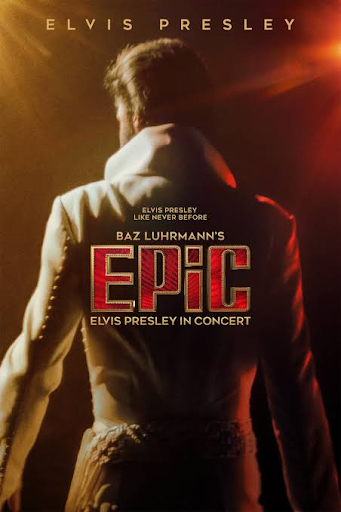
“I learned very early in life that: ‘Without a song, the day would never end; without a song, a man ain’t got a friend; without a song, the road would never bend – without a song.’ So I keep singing a song,” Elvis Presley once said.
A few of many monumental words spoken by the King of Rock and Roll, audiences of Elvis fans worldwide now have the opportunity to see “EPiC” — Elvis Presley in Concert. Featuring all-time favorites like “That’s Alright Mama,” “Burning Love” and “Suspicious Minds,” theatergoers are transported back in time to Presley’s sold-out crowds of the 1960s and 70s.
Legendary Australian director Baz Luhrmann directs the documentary-style special featuring never-before-seen footage and previously unheard music of Presley. Known for directing films such as “The Great Gatsby” and “Moulin Rouge,” “EPiC” is a response to his 2022 biopic “Elvis,” starring Austin Butler as the Memphis artist and Tom Hanks as his deceitful manager, Colonel Tom Parker.
Upon the release of “Elvis,” a surge of nostalgic fervor reignited, leaving loyal fans and new ones in a frenzy. Less than four years later, Luhrmann created “EPiC” to “let Elvis tell his own life.” To uncover the lost footage, Luhrmann sent researchers to a salt mine in Kansas, where they found 65 reels of footage — roughly 10 – 16 hours. Additionally, a 40-minute interview of Presley from his “Elvis on Tour” (1972) concert film was unearthed.
“[The tape] was our light-bulb moment,” Luhrmann said. “Because Elvis was off camera when it was taped, I think he was really unguarded and really open hearted. We thought, ‘What if we use this in the film so that Elvis tells his story himself?’”
Large segments of the film showcase his 636 performances delivered throughout his residency at The International Hotel in Las Vegas. Avid “Elvis” viewers will instantly recognize the meticulousness Luhrmann possessed when watching this movie. Specific shots of Butler, like the scenes of him walking with his entourage, are spot on to what is seen in real life; the look, pacing, demeanor and expressions evoke a strong sense of déjà vu.
Nevertheless, Butler is no match for the sheer aura that was Presley. His ability to captivate women was overwhelmingly apparent, and every man would have died to be him. All six feet of him, draped in his low-cut white jumpsuit, looked like a complete Adonis with those blue eyes, luscious hair and that charismatic smirk.
And the accessories! Bling, bling and more bling. With the variety of rings and belts this man had, every theatergoer is bound to have a favorite. All different shapes, sizes and colors, yet always adorned in gold. His silk, vibrant dress shirts worn in his rehearsal sessions, paired with his TCB — Taking Care of Business — shades, accentuated his larger-than-life stage persona.
Presley worked like a dog. Colonel Parker would book him for several performances a day, cast him in more than 30 films that he despised and kept him trapped in the United States, despite his desire to tour the world. Receiving countless questions from reporters, he was often asked if he was satisfied with the image he had built.
“Well, the image is one thing, and the human being is another,” Presley said — implying that underneath the glamor, no individual can endure the struggles of stardom.
The rehearsal footage was the centerpiece. Watching his purposeful dance moves, paired with the spontaneity of his personality, was such an intimate experience. In those sessions, his intuitive musicality was entirely evident, particularly in gospel songs. A genre taught to him by African American congregations and artists, it was a style he often returned to.