Students gathered in Founders Ballroom B in the Oakland Center from 2 to 5 p.m. Thursday, Feb. 12, as Oakland University Student Congress partnered with university administrators to host the final round of the Sustainability Shark Tank, a campus-wide initiative and competition created to turn one winning student’s idea into tangible environmental improvements.
Modeled after the recognizable reality television series “Shark Tank,” the event brought five student finalists to the stage to pitch sustainability proposals to four administration-member judges, or “Sharks.”
The first-place proposal would receive a $5,000 implementation budget backed by the OUSC and OU administration, along with oversight through April, and additional prizes awarded across categories.
The initiative was designed and organized by OUSC Director of Sustainability Riley Demond, who said the goal was to create a space where student ideas could realize environmental goals with resources and oversight from both administrators and other experts.
“It was actually inspired by the efforts of Christopher Reed and Dr. Mozhgon Rajaee,” Demond said. “They started a sustainability committee a few years ago, but they never got enough funding to actually follow through with it, so I took it upon myself to use our OUSC funding.”
Demond said the “Shark Tank” format was intentionally chosen to make the process accessible and engaging for students unfamiliar with administrative proposal processes.
“People know the ‘Shark Tank’ name, and they know what a business proposal for ‘Shark Tank’ looks like,” Demond said. “The vibe, it’s fun. I thought it’d be a great idea to have students bring their ideas on stage and compete to make an impact on our campus.”
Following an application period and a series of one-on-one preparation meetings, the field was narrowed to five finalists representing a wide range of academic backgrounds.
Student proposals included a campus waste audit, a push for brine solution as a green alternative to road salt for de-icing sidewalks, the cutting down of single-use plastic waste by incorporating reusable mugs at Kresge Library, an app that incentivizes documenting sustainability efforts while walking routes, and an ecological restoration plan for Bear Lake.
“These students were very interested, inspired and they had so much dedication and heart in their presentations,” Demond said. “I’m very proud of the ideas and dedication each of these students have shown.”
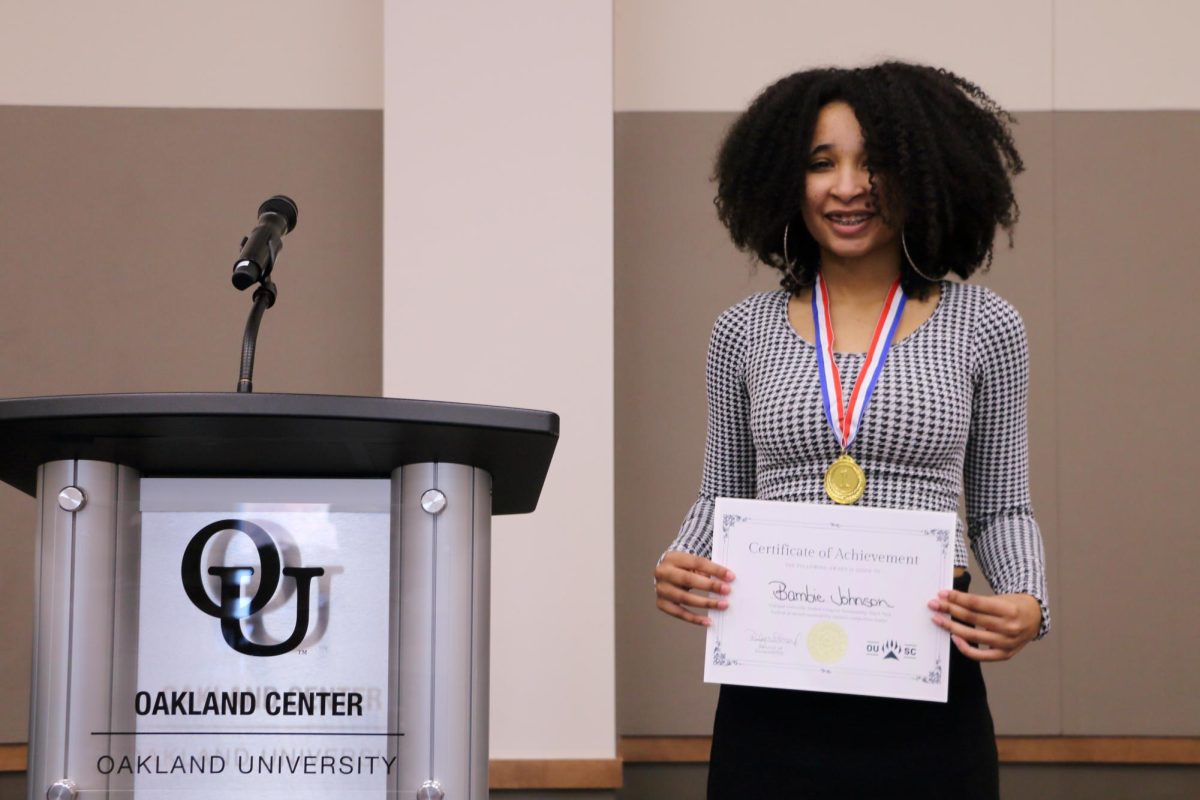
After each presentation and a closed-door deliberation, judges awarded first place to sophomore Bambie Johnson for “Saving Bear Lake,” a proposal focused on shoreline restoration, vegetation growth and habitat improvement. Johnson also received the Ecosystem Engineer/Most Inventive Award, determined by audience gallery voting.
Stepping off the stage, Johnson felt both surprised and honored.
“I was shocked,” Johnson said. “I definitely put a lot of work into the project, but honestly, everyone’s ideas were amazing.”
Johnson, an electrical engineering major with a minor in computer science, said the project reflects a desire among students to engage directly with environmental work on campus.
“I feel that students really want hands-on experience in doing something for their communities,” Johnson said. “This project is a fantastic way to actually be able to go about it.”
With the competition concluded, Johnson said implementation will begin immediately, starting with expert consultation.
“My next move is going to be meeting with the biology department,” Johnson said. “We’re also going to be getting in touch with coordinators from the Clinton River Watershed Council to determine what is feasible to do with the lake.”
Demond said OUSC will work closely with Johnson and volunteers throughout the semester to ensure the restoration project is implemented and publicly documented. She hopes the Sustainability Shark Tank becomes an annual tradition carried on by future student leaders.