In the Oakland University School of Music, Theatre and Dance (SMTD), Oakland Opera students took George Frideric Handel’s “Alcina” and readapted it with a modern twist in Varner Hall.
The 18th century Baroque work is a fascinating fantasy: a beautiful island belonging to an enchantress who turns any seduced onlooker to stone. Despite its many fictional elements, themes of deception, reality versus illusion and love versus lust leave the audience in deep rumination.
Drake Dantzler, professor of music and voice opera program coordinator, began a quest in June of 2025 to update the opera in collaboration with ChatGPT, placing extra emphasis on the real versus fake message as it relates to modern-day contexts. He found social media to be a key example of this dichotomy.
“I was trying to think, ‘What are things that are really important to artists right now, especially young artists?’ And so we incorporated social media topics and AI topics to engage with modern performers and audiences,” he said.
The libretto was translated from Italian into English via AI-assisted text generation, and the phrases were updated in particular sections to fit modern-day lingo. Who would have thought “you toxic wrecking ball” was used in 1735?
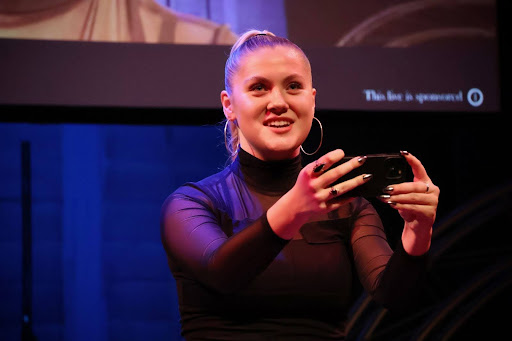
A storyline that could have been distantly related to “Clash of the Titans” or “The Witches” rapidly transformed into an influencer house, “The Curio.” Actors walked around the stage taking selfies, hosting lives and interacting with viewers. Sitting in front of a greenscreen, characters projected themselves to viewers with picturesque backdrops, illustrating an expansively luxurious mansion.
One of the first characters spotted was Morgana (Charlotte Jiang), Alcina’s sister, whose love interests are Ricciardo (Trinity Green-Conner, Andrea Valenzuela-Lazcano) — Bradamante in disguise — and Oronte (Maximilian Ulrich), whom she eventually abandons.
Assuming the role of Alcina was Mila Pitman, junior Vocal Performance major (portrayed by Carys-Rees Baker on alternate nights). This was Pitman’s second lead role as a student in SMTD. Alcina could be seen fighting and reconciling with a myriad of lovers, including the knight Ruggiero (Sarah Lawlis, Paige Colby), and her general and former lover, Oronte.
Pitman delivered it all: volume, vibrato, diction and tremendously natural acting. The emotional outbursts in her arias were nothing short of extraordinary. The way characters interacted with each other on camera versus off mimicked that same relationship that consumes today’s society.
Pitman expressed the viewpoints she had developed about Alcina after playing her in the production’s first performance.
“I feel like every villain has a backstory, and Alcina being so incredibly famous online works in the same way, knowing how our real-life influencers have grown to become famous,” Pitman said. “When she first began gaining traction on social media, people loved her for her authenticity and relatability, but when that number of followers started to plateau, she had to try new ways to gain people’s attention, costing her to lose her own sense of self.”
She went into further detail, divulging the complex association between the self on and off the internet.
“She isn’t consciously lying all the time; she’s performing the version of herself that gets rewarded. Over time, that performance replaces her real identity,” Pitman continued. “As an actor, that meant constantly asking who she was when the camera is on, and who she was when it’s off. The tension between those two selves really heightened the theme of real versus fake for me.”
Well done to Oberto (Lauren Hummer) and Melisso (David Glazkov) for such spectacular vocal technique.
The orchestra was led by Victoria Shively, OU SMTD professor and conductor/music director of “Alcina,” who assisted Dantzler in the creation of this endeavor. In the process, they recognized the irony and caution that must be taken when merging AI with the arts. They hope the audience left the performance reflecting on that liaison.
“Where does AI fit in the world of art? It’s a very complicated, very nuanced question. Evaluating what is a tool and what is not a tool, and what’s human and what’s not human when working with AI is a new, complex endeavor,” Dantzler said.