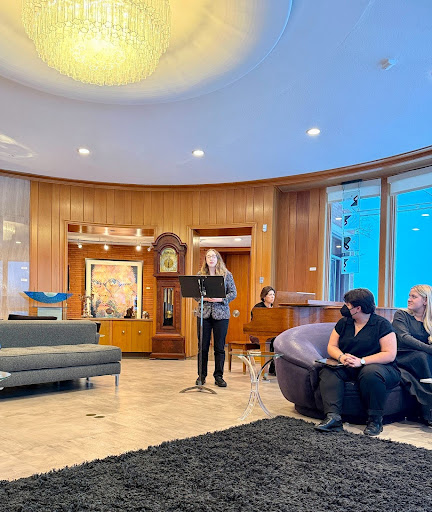
Undergraduate and graduate vocal students at Oakland University performed at Sunset Terrace — President Pescovitz’s on-campus residence — as part of their final exam on Dec. 10.
Due to several high-temperature hot water (HTHW) pipe leaks, Oakland University students have had an unprecedented end to their semesters. Many have attended class virtually, continued to work asynchronously, taken exams in designated buildings or have had to submit work completely online.
For students in the School of Music, Theatre and Dance (SMTD), this posed a unique challenge. The majority of individuals in the music department are asked to perform at the end of each semester, improving technique and musicality over time.
In Professor Victoria Shively’s MUS 4561 and 5561 Vocal Repertoire course, students had both written and performance exams to complete on American and British Art Song. President Pescovitz, a pianist and steadfast advocate for the arts, generously extended the invitation to Shively and her students to perform at her residence.
“This is the definition of turning a difficult circumstance into an amazing memory for those singers/students!” Shively said.
Through a series of in-class journal entries, performances and coaching, vocalists explored modern American and British repertoires from every decade since 1900. Students were assigned three pieces throughout the semester: a British art song, either modern or early English American, an earlier American versus more modern and then one of 24 Italian songs and arias.
The afternoon was split into five sets: spirituality, complicated love, despair, comfort in nature and new love.
Pieces in the American and British repertoire are typically poems set to music. The poem “Prayer” for instance, text by Harlem Renaissance poet Langston Hughes, was placed in a musical context by H. Leslie Adams.
In the spirituality section, junior Holly Zamojski sang “At the River” by Aaron Copland and text by Robert Lowry. Text painting — melodic contours, rhythmic material or even harmonic language — is a key characteristic of the genre of art song. An open chord, for instance, may translate to the sadness of a protagonist. Meanwhile, sixteenth notes in a fast tempo and major key likely indicate happiness or joy.
Students who were absent due to road conditions received recognition and had the text of their pieces read aloud as they observed via Zoom.
Senior Emma Latourette opened the complicated love chapter with “My Lizard” by Samuel Barber and text by Theodore Roethke. In this piece, the piano and voice imitate each other and sit comfortably within one another, rather than fighting.
Despair was depicted first by graduate student Carys Rees-Baker as she sang “Ophelia’s Song” by Maude Valerie White and words by Shakespeare from “Hamlet.” An atmosphere of melancholy and yearning was continued, as graduate student Cate Gasco performed “Longing” by Adolphus Hailstork and text by poet Paul Laurence Dunbar. Junior Mila Pitman closed the set with “Night Song at Amalfi” by Amy Beach and words by Sara Teasdale.
Pitman, a double major in Vocal Performance and Music Education, came in completely blind to this opportunity and ended up loving every minute of it.
“This space was beautiful to sing in and it is circular, which is really nice for acoustics,” Pitman said. Singing is definitely a challenge online, especially when trying to line things up with an accompanist, so I’m very grateful to have this experience.”
Senior Sarah Lawlis brought forth a fantastic rendition of “Rain in Spring” by Ned Rorem and words by Paul Goodman for the comfort in nature set.
To close the final set, junior Andrea Valenzuela-Lazcano stunned the audience with “You Ask Me if I Love You” by Harry T. Burleigh and words by Lillian Bennett Thompson. Singing about new love, Valenzuela-Lazcano encapsulated every emotion discovered throughout the entire series of performances to exhilarating completion.
Lawlis, like many others, enjoyed the hope for humanity that Valenzuela-Lazcano’s piece possessed.
“Compositionally, ‘You Ask Me if I Love You’ was one of my favorites because it has so much wholesome love and it really builds with those chords,” Lawlis said. “It’s simplistic, but not simplistic to sing, because if the intention or passion are not there, it falls flat. So I think Andrea did a very beautiful job and it was so inspiring to have so many art pieces around.”
Although it was a challenging end to the fall semester, vocal students did receive a small audience after all.
David Kidger, Ph.D., Associate Professor of Musicology, Music History Program Coordinator, was thoroughly impressed by the talent and hard work of the students.
“I genuinely enjoyed every piece and the way everything fit together. This was such a wonderful opportunity for them to be in a beautiful space with beautiful acoustics and it’s an important experience to get used to singing in new spaces and being able to adapt on the fly…They can adapt to an audience, large or small and give everything into the performance,” Kidger said.