


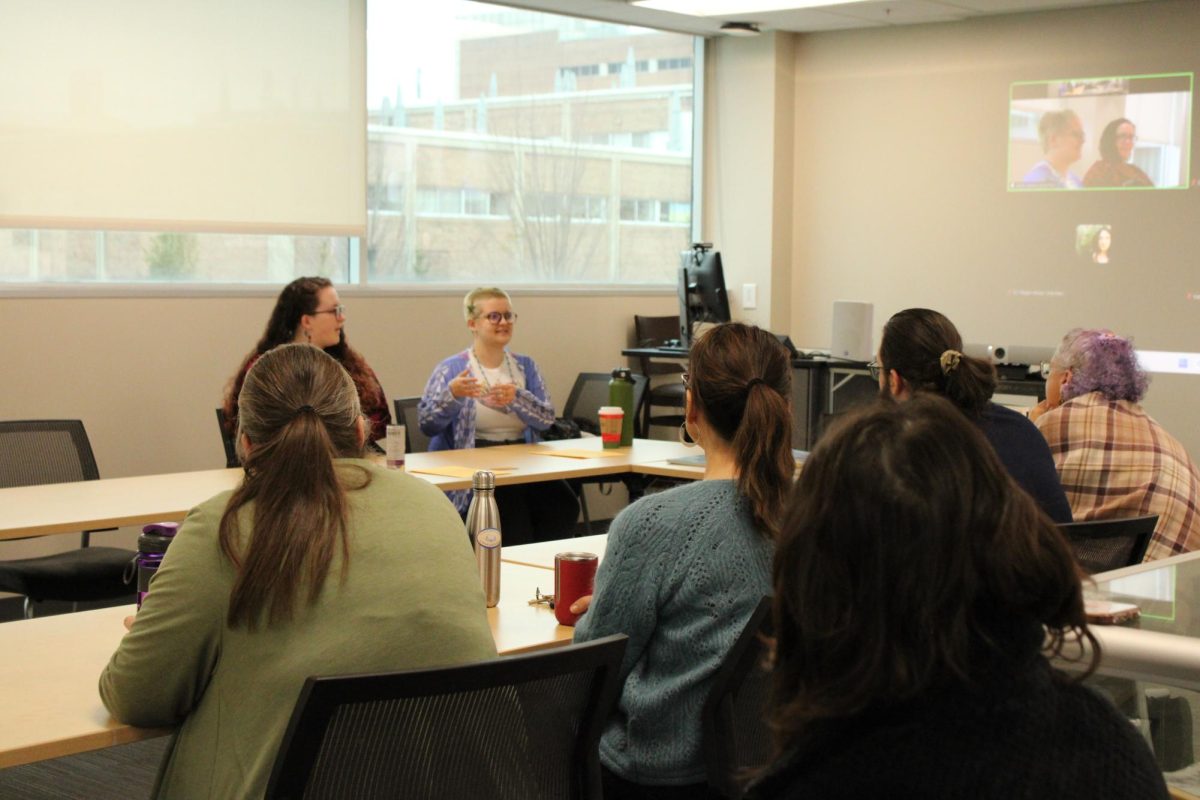
With questions on identity, activism and inspiration, the Native American Artist Panel explored the art scene at Oakland University and the advances Native American students have made in their personal projects and national conversation.
Moderated by the Associate Dean of Kresge Library, Beth Wallis, the panel featured two OU artists. Sada Reed and Katie Kraemer, both multidisciplinary artists and OU alumni, explored themes like displacement and remembrance, shared their creative process and questioned the place of art in everyday life.
“My inspiration for much of my work is the lack of concrete documentation of Native American culture and Native American people,” Kraemer said. “The concrete photos or writings that we have about Native American people have often been skewed by colonist viewpoints or photos that do not tell the true story of the Native American existence. My goal is through my photography to make an honest documentation of my life and the lives of other people around me.”
Technique, subject matter and medium are all influenced by tradition and culture. Under that premise, Wallis allowed the panelists to explore the themes behind Kraemer’s photography and Reed’s sculpture.
“My most recent piece was about displacement and chronic pain that I deal with on a day-to-day basis,” Reed said. “A lot of my inspiration is just coming from myself and what I’ve been ruminating on a lot, which is also where the pacing around with a journal comes in because it’s just what’s naturally coming to me and what is from my thoughts.”
From epiphanies that inspire a piece to the planning phase of assembling the materials necessary, both artists offered a look behind the curtain of their finished pieces.
“A lot of times, when it gets to a point where I kind of have to ask, ‘Is this salvageable or is this not?’ If it’s salvageable, I’m gonna put work into it, not eat, not sleep until it’s ready, because I’ll have nightmares,” Reed said. “But if it isn’t salvageable, that’s when I cannibalize it. I cannibalize it. I just take it apart, use the materials for something else, like I have a step-by-step, because it happens a lot.”
Beyond the museums and galleries, the panelists explained that art and culture are often one and the same — alive in the quotidian details of our identity.
“A lot of community and culture in Native American communities is art,” Kraemer said. “Every culture does that and you just don’t know it, because Native American culture tends to highlight it and revere it as a sacred part of our culture. But everybody does it every day, in a way, when you put on makeup in the morning, or you pick out your outfit. You pick it out sort of as armor to wear for the day of how you wanted to represent yourself.”
As an effort to take art to places other than the glass displays or monuments, the artists explained that OU’s art scene is growing alongside the students’ discipline and interests — not without challenges.
“People are afraid to go to the studio, especially post-COVID, like people aren’t showing up to a lot of stuff,” Reed said. “The gallery is open and free for everyone, not just students. We have art all in the basement of Wilson Hall. There are installations all over. There are installations in the library. So there is an art scene. It just feels like a lot of people don’t necessarily know about it.”
At the end of the day, both panelists agreed that art and exploring identity through art is as necessary as breathing, a part of life that does not fade with the paintings or crumble under sculptures.
“There comes a time in every artist’s life, where you go, ‘Oh, it’s the way my brain works,’ that’s why I’m an artist,” Kraemer said. “You visualize the world in pieces, instead of as a whole. And then after you’ve understood the pieces, it comes together as a whole, which is the same way art works. So you have to sort of come to this realization that, ‘Oh, I’m an artist.’”


Sheran Wallis • Dec 2, 2025 at 12:43 PM
Thank you.
Great insights!