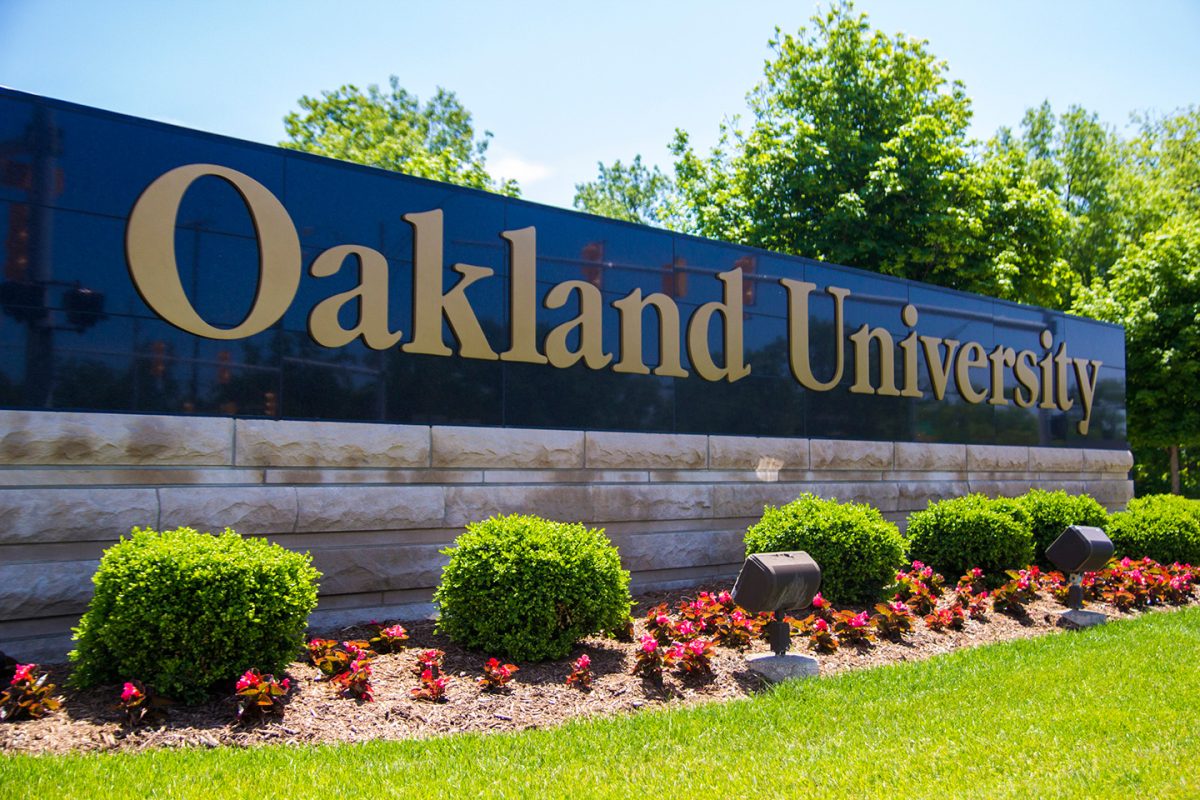
Oakland University students, faculty and community organizations gathered at the Habitat in the Oakland Center on Thursday, Oct. 30, for the second annual Beaver Fest, a celebration of the university’s resident beaver family and a call for greater environmental sustainability awareness on campus.
The two-hour event was hosted by OU Student Congress and Team Beaver — an interdisciplinary group consisting of faculty and students led by Student Congress Director of Sustainability Riley Demond. The event was held in conjunction with several local organizations including CASE-OU, the Sierra Club, the Michigan DNR, Huron-Clinton Metroparks, Stage Nature Center, Botany Club and the city of Auburn Hills. Attendees enjoyed educational booths from the visiting organizations, cider, snacks, themed tote bag painting and a trail camera footage display curated by associate professor of biological sciences, Sandra Troxell-Smith.
“After hiring into my current position, everyone asked about Beaver Fest right away,” Demond said. “We’re trying to do a whole thing of protecting our resources, our water, and our animals on campus – beavers as well.”
Coordinators and speakers had fun dressing up a bit while educating – Demond’s beaver costume was a hit. Costumed as a 17th-century fur trader, Charlie Shelton, community outreach interpreter for Huron-Clinton Metroparks, discussed the beaver’s historical importance to Michigan. He urged students to combat ecological amnesia, an increasingly prevalent outlook in which environmental degradation is, over generations, simply accepted as the new normal.
The Post first reported a mature beaver pair having moved to Galloway Creek early last year, and Troxell-Smith’s footage this summer indicated the pair had since given birth to a baby beaver, known as a kit. Subsequent footage, projected against the Habitat’s north wall, was a key event feature.
The display showed highlights of the beavers’ dam and lodge maintenance in the thriving wetland. In a previous interview, Troxell-Smith indicated that students, staff and wildlife can share the preserve space, presenting an ideal circumstance for study.
“It was a really great opportunity for us because of where the beavers set up their dam,” she said. “Their lodge is close enough that we can monitor them easily, and students can actually go see the effects of their work for themselves. It’s really exciting to know that this is right in our own backyard.”
Beaver Fest built upon the enthusiasm with ardent concerns regarding human responsibility. Annie Gilson, associate professor of English and creative writing and a member of the Sierra Club, said she attended to help educate students about current potential environmental threats – including the development of a new data center on existing OU parking lot 35.
Gilson said the Sierra Club – the oldest environmental group in the country – has opposed the construction of large data-processing facilities across Michigan due to their energy consumption and water use levels. She added that the club maintained a presence at the Michigan Regulatory Committee, speaking out about the center’s development on campus land near the preserve.
“We want regulations to control how much power the data centers take from the public grid and how much water they consume,” she said. “I want students to remember that this is their world. They need to feel that they have agency – that they can take charge of and preserve it.”
Thomas Raffel, associate professor of biological sciences, previously noted that beaver dams can provide natural flood control and erosion prevention, and Demond emphasized their ecological value as a keystone species that supports biodiversity.
“They create wetlands that act like the kidneys of the earth, filtering pollutants and protecting biodiversity,” Demond said. “There can be coexistence for all.”
Coexistence was central to the event’s planning, according to Nicholas Skinner, Auburn Hills Department of Recreation program leader, OU alum and former Director of Sustainability, who helped organize last year’s inaugural Beaver Fest.
Skinner said lessons learned from last year’s debut helped grow this year’s Fest, offering an even more diverse breadth of engagement. He hopes the collaboration between environmental groups and student organizations continues to expand.
“These events are important, not only for campus, but for the wider state and regional environment as well,” he said. “The more people that learn and care about beavers, the more conservation projects we can get going. Beaver habitats offer carbon sinks and wetland habitat growth. They’re just so important.”
The event also encouraged direct student involvement. Skinner noted that volunteers are needed to help install kiosks and benches along the newly formalized trails within the preserve, part of a broader effort to make the area more accessible.
Attendees asserted that sustainability events are a welcome presence on campus. Thomas Wayne, an OU student participant, said he appreciated the turnout and the informed awareness the event fostered.
“I want other students to care about sustainability on campus and take something from what they may have learned or heard about here and implement it in their own lives,” he said. “The one thing we can’t live without is outside, so if we don’t uphold that, we’ve kind of lost.”
Beaver fans and sustainability supporters can help to uphold the outdoors by volunteering and keeping up to date with animal activity through the Animal Behavior Instagram page and YouTube channel.
Organizers expressed hope that Beaver Fest will continue to grow each year. Skinner said the event’s success reinforced the importance of campus engagement in conservation work.
“It’s awesome to see everyone come together,” he said. “One of the professors had the idea for Beaver Fest last year, and I’m just so glad to see it continue this year. We’re hoping for a third, fourth, fifth, and to just keep going.”