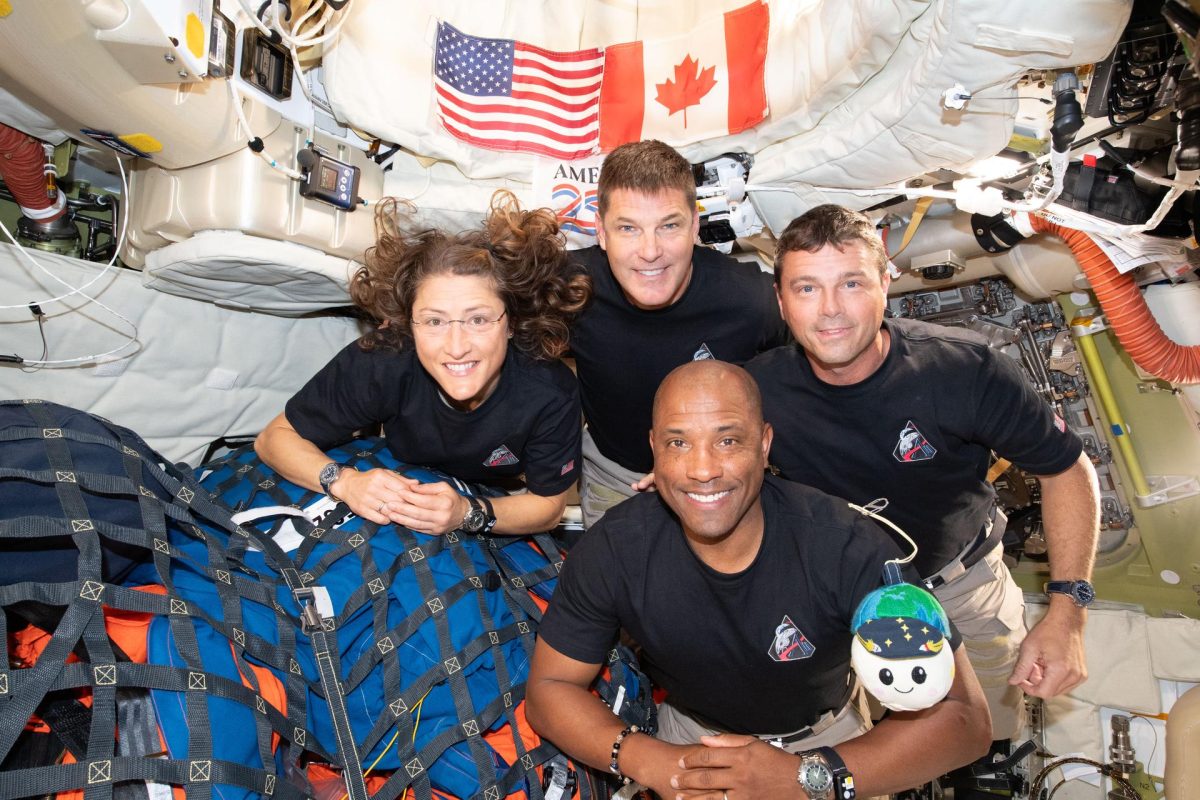
As NASA’s Artemis II mission returned to Earth after a historic journey around the moon, the milestone is capturing attention and inspiring a new generation of students. The mission signals a renewed era of human space exploration.
According to NASA, Artemis II sent four astronauts on a mission around the moon to test critical systems, including the Orion spacecraft and Space Launch System rocket. The mission was designed to ensure that life-support, navigation and population systems are ready for future missions.
The Artemis II crew included Reid Wiseman, Victor Glover, Christina Koch and Jeremy Hansen. While the mission did not include a lunar landing, it served as a key step in NASA’s Artemis program.
The crew safely returned to Earth after completing the mission, marking the first crewed journey around the Moon in more than 50 years. The success highlights the growing potential for future deep-space exploration.
For students at Oakland University, the mission represents both excitement and uncertainty about the future of space exploration.
Emilio Eslava, a senior electrical engineering major at OU, said the mission reflects early progress in long-term space exploration efforts and a promising sign of what may be to come.
“It’s a great start, but we’re still a few years away from a Moon landing,” Eslava said.
Eslava said continued progress could lead to future missions beyond the Moon.
“If we keep doing this, we might get to Mars in 20 years,” Eslava said.
Eslava said the mission inspired trepidation leavened with admiration for the crew.
“I’m scared of outer space, but I really admire the astronauts, ” Eslava said.
Christopher Kobus, a professor of mechanical engineering at OU, said the Artemis II mission marks another momentous move toward broader contemporary space exploration.
“The Artemis II mission is a milestone in modern space exploration because it marks humanity’s return to the lunar vicinity for the first time in more than 50 years,” Kobus said.
Kobus said the mission highlights how concepts learned in the classroom apply to real-world challenges.
“For engineering and STEM students, watching this unfold is inspiring because it transforms textbook theories into tangible reality,” Kobus said.
Richard Olawoyin, a professor of industrial and systems engineering at OU, said risk and safety are central to every decision in a mission like Artemis II.
“Risk is what could go wrong, and safety is everything done to prevent it or survive if it happens,” Olawoyin said.
Olawoyin said engineers must anticipate both known risks and uncertainties.
“Critical systems are duplicated, extensively tested and designed to respond in real time if something goes wrong,” Olawoyin said.
Daniel Aloi, a professor of electrical and computer engineering at OU, said communication systems are essential to missions like Artemis II.
“The communication system is the lifeline of a mission like Artemis II,” Aloi said.
Aloi said deep-space missions rely on strong technical foundations.
“Artemis II runs on the same fundamentals students learn in engineering courses,” Aloi said.
Artemis II represents a shift from short-term missions to long-term planning in space exploration. The mission highlights the importance of innovation, collaboration and the role of future scientists and engineers.