Sarah is a popular name, especially in film. With both writers sharing the name, this theme felt like a fun and perfect fit. These films highlight salient, or standout, characters named Sarah who each bring a different story to the screen and are worth the watch.
“The Terminator” (1984)
If there is one Sarah that truly defines this theme, it is Sarah Connor (Linda Hamilton) from “The Terminator.” The action and sci-fi film is a classic and remains popular with audiences for a reason. It is packed with action, moves quickly and keeps viewers on the edge of their seat the entire time.
The story follows Sarah Connor, a woman whose life is suddenly turned upside down when she is targeted by a machine sent from the future to hunt her down. At first, there is no clear explanation, but it is soon revealed that her future son will play a major role in saving humanity. Because of that, Sarah becomes the target of the Terminator, a nearly unstoppable machine.
Along the way, she meets Kyle Reese (Micheal Biehn), a soldier sent back in time to protect her. He provides information about the future and explains why she is being tracked down. Sarah is constantly running, hiding and trying to survive. No matter how far she runs, the Terminator always seems to find its way back to her.
What makes the film inspiring is Sarah’s transformation. At the beginning, she is overwhelmed and struggling to understand the situation. As the film continues, the danger forces her to adapt and grow stronger. Reactions become quicker and survival becomes the priority.
This transformation is what makes Sarah Connor such a memorable character. Strength develops through the challenges she faces throughout the film. The nonstop action and intensity add to her growth as a character.
“Jumanji” (1995)
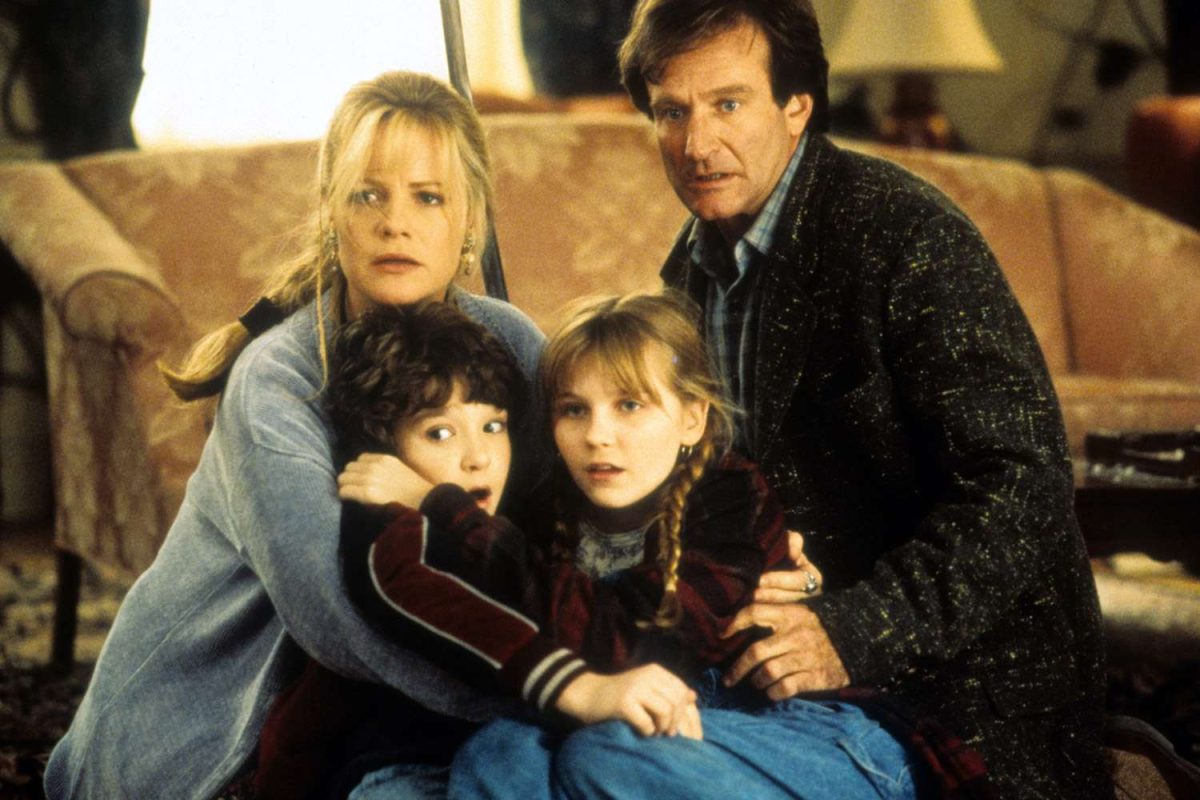
Another film that fits the theme would be “Jumanji” featuring Sarah Whittle (Bonnie Hunt). The family and adventure film stands out for its wild storyline and the unpredictable moments it constantly brings along. Each turn of the game releases dangers into reality, adding constant action and intensity throughout the film.
The story centers around a magical jungle-themed board game that brings everything to life. When two children Judy Shepherd (Kirsten Dunst) and Peter Shepherd (Bradley Pierce) begin playing the game years after it was first discovered, Alan Parrish (Robin Williams) is released after being trapped inside for decades. The only way to stop the chaos is to finish the game, which involves finding Sarah Whittle, the last person who played the game with him as a child.
Sarah’s role shows how the game continues to affect her. As a child, the experience was terrifying which led to years of disbelief. As an adult, she tries to move on, but when brought back into the game, those same fears return back to her.
Although hesitant, Sarah becomes essential to completing the game. Her return to Jumanji requires confronting the past and accepting the reality of what once seemed impossible long ago.
What makes this character stand out is the emotional growth shown throughout the film. Strength is not only shown through constant action, but through the willingness to face past experiences and move forward. The mix of adventure and character development makes Sarah Whittle a memorable addition to the character list.
“Sarah, Plain and Tall” (1991)
Based on Patricia Machlahan’s Newbery Medal-winning novel of the same name, “Sarah, Plain and Tall” is a heartwarming film about family and second chances. Set in 1910, the film centers on Jacob Witting (Christopher Walken), a farmer whose wife passed away in childbirth some years ago. Struggling to care for his two young children, Anna and Caleb, he advertises in the newspaper for a mail-order bride.
In Maine, Sarah Wheaten (Glenn Close) sees his advertisement and agrees to travel to Kansas to meet the family and stay with them for a trial period of one month, before deciding whether she will marry Jacob. In her letter answering the advertisement, Sarah self-deprecatingly describes herself as plain and tall. Arriving in Kansas, she finds the dusty plains much different from her coastal Maine and struggles with homesickness.
Subverting the evil stepmother trope, Sarah is compassionate towards the motherless children and quickly becomes attached to them. Caleb and Anna learn to happily accept Sarah into their lives, but they also wonder whether they are enough to convince her to stay in Kansas despite her deep homesickness.
The movie also has two sequels, “Skylark” and “Sarah, Plain and Tall: Winter’s End,” that are based on the subsequent novels. While the films are low-budget and made for television, the cinematography of rural America is breathtaking, and the feel-good story compensates for any flaws.
“Save the Last Dance” (2001)
An early 2000s dance film, “Save the Last Dance,” focuses on the teenage character Sara (Julia Stiles). After her mother passes away in a car accident while driving to Sara’s dance audition, Sara gives up dancing completely, feeling guilty for her mother’s death and abandoning her goal of becoming a dance student at Juilliard.
Upending her entire life, Sara moves to live with her father, Roy, in Chicago’s South Side. Sara’s father has been estranged for a long time, and to add to her sense of displacement, Sara is one of the very few white students at her new high school and feels out of place among her fellow high schoolers. However, she begins a tentative friendship with Derek Reynolds (Sean Patrick Thomas), who dreams of becoming a pediatrician at Georgetown University one day.
When Derek learns that Sara used to dance, he motivates her not to give up on her dream and continue dancing. While Sara was rigorously trained in the strict dance discipline of ballet, Derek introduces her to hip hop and encourages her to let loose and regain her love of dance.
The film is undoubtedly full of early 2000s movie cliches, but Sean Patrick Thomas and Julia Stiles both do their best to bring complexity and depth to their respective characters. While seemingly predictable, the story is not tied up quite as a viewer would expect. The film also touches on important topics such as family relationships, teen parents and interracial relationships.