


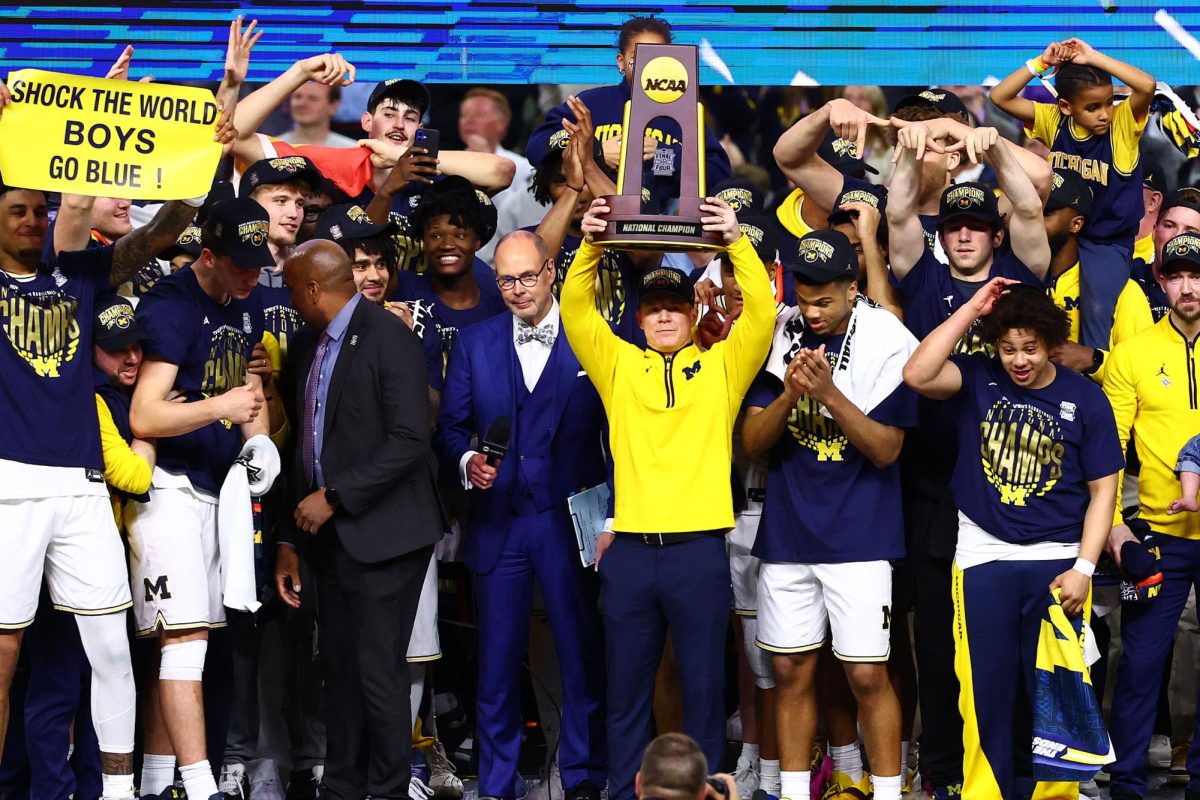
The University of Michigan men’s basketball team cemented themselves into college basketball history on April 6, 2026, after defeating the University of Connecticut men’s basketball team 69-63 to secure the program’s second NCAA national championship in its history.
In a game defined by physicality, defense and resilience, Michigan leaned on grit rather than efficiency to outlast an unwavering UConn team. The Wolverines’ victory marks their first national title since 1989 and caps a dominant tournament run that showcased their depth, toughness and ability to adapt under pressure.
Michigan guard Elliot Cadeau delivered his second straight standout performance, scoring 19 points and earning Most Outstanding Player honors for the Final Four. Cadeau’s leadership proved crucial, especially in the second half, as the Wolverines worked to maintain control in a tightly contested game.
Despite struggling from beyond the arc throughout the contest, Michigan found consistent success inside the paint and at the free-throw line. The Wolverines compensated for their shooting struggles with aggressive drives, strong rebounding and near-perfect execution at the line, converting 25 of 28 free throws.
UConn, led by head coach Dan Hurley, entered the championship game looking to add another title to its recent run of dominance. The Huskies kept the game within reach throughout, fueled by strong rebounding and key performances from forward Alex Karaban, who recorded a double-double with 17 points and 11 rebounds.
However, offensive struggles ultimately proved too costly for UConn. The Huskies shot just over 30% from the field and were unable to generate consistent scoring against Michigan’s physical defense. Turnovers and missed opportunities down the stretch prevented them from completing a late comeback.
The Wolverines disrupted UConn’s offensive rhythm, contested shots effectively and limited second-chance opportunities despite being out-rebounded. Their ability to control the tempo and force difficult possessions played a key role in securing the victory over the Huskies.
The win also highlights a broader shift in college basketball, as Michigan became the first national champion to start five transfer players. The Wolverines’ rebuilt roster reflects the evolving landscape of the sport, where the transfer portal and name, image and likeness opportunities have reshaped how teams are built and sustained.
Head coach Dusty May, in his first season leading the program, completed a remarkable turnaround. After inheriting a struggling team, May guided Michigan to a championship through a combination of disciplined defense, balanced scoring and a strong mentality.
For UConn, the loss ends an impressive stretch that included multiple Final Four appearances and national titles in recent years. While the Huskies fell short, their performance throughout the tournament reinforced their status as one of the premier programs in college basketball.
As the final buzzer sounded, Michigan players celebrated a long-awaited return to the sport’s pinnacle. The Wolverines’ championship run will be remembered not only for the title itself but for the resilience and determination that carried the team to game-over-game dominance.
With a new era of college basketball continuing to take shape, Michigan’s victory serves as both a culmination of a historic season and a glimpse into the future of March Madness.