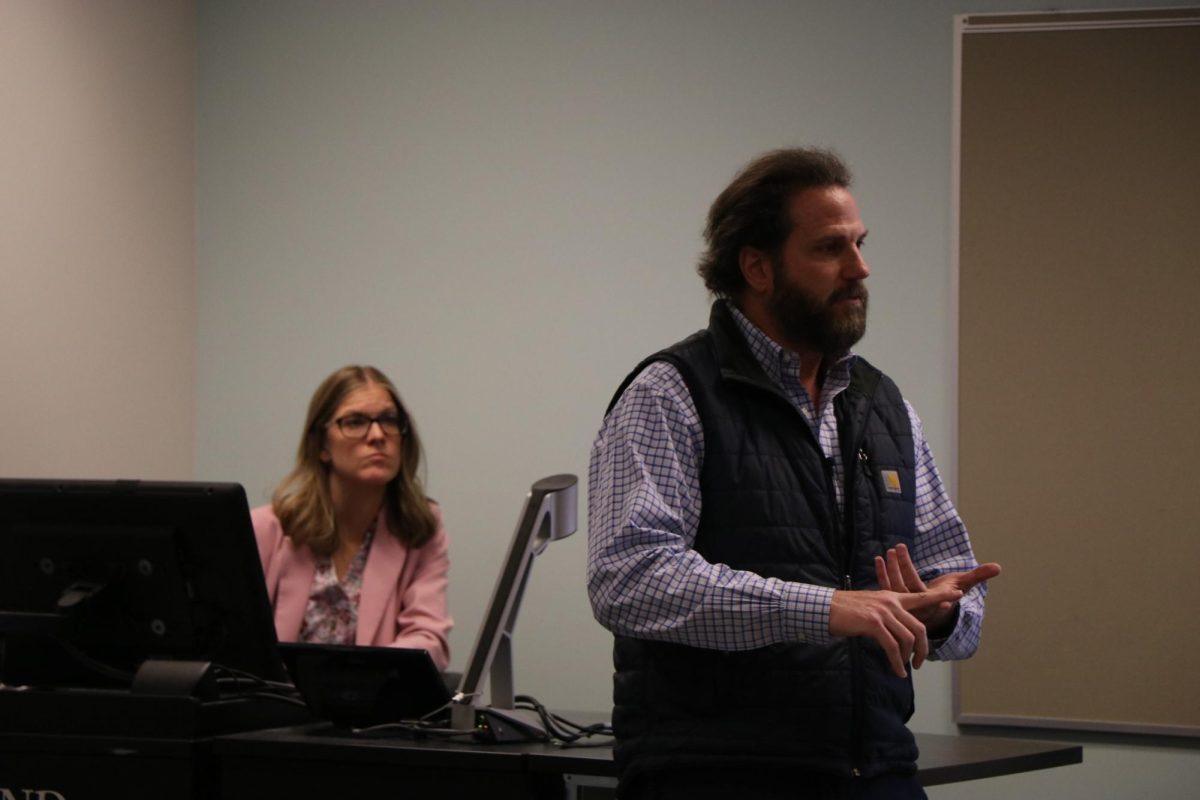
Oakland University students gathered for a PACE-hosted “lunch and learn” on Thursday, April 9, from 12 p.m. to 1 p.m. in Pawley Hall, Room 306, to explore careers in the legal field.
The event introduced students to the paralegal profession in a relaxed and accessible setting while highlighting pathways into the field for students across a variety of majors. Attendees learned about the profession, asked questions and connected with program leaders in a more personal, discussion-based environment.
Hosted by Professional and Continuing Education (PACE), the session aimed to provide students with a clearer understanding of how paralegals contribute to the legal system and what steps are needed to enter the field.
PACE, led by Oakland University faculty and administrators, offers opportunities for students to gain practical job knowledge and skills through research and hands-on application.
The program emphasizes career readiness and provides resources for students looking to build experience before entering the workforce.
The program offers flexible learning options, including evening and online classes, allowing students to gain experience while continuing their studies.
Through career-focused certificate programs, PACE aims to prepare individuals for entry-level positions or advancement within their current careers.
Carrie Sliwinski, assistant director of PACE, said the university developed its paralegal program in response to a growing demand for trained legal professionals in the region.
“Our Paralegal Program was created to meet a growing regional need for well-trained legal support professionals. As the legal field expanded and the demand for skilled paralegals increased, Oakland University saw an opportunity to offer a rigorous, ABA-approved program,” Sliwinski said.
This year marked the program’s 50th anniversary, reinforcing its long-standing presence and continued relevance in the legal community.
Over time, the program has built a strong reputation for preparing students with practical skills that can be directly applied in professional settings.
Students who complete the PACE program are met with a range of career opportunities. The curriculum is designed to provide both foundational legal knowledge and hands-on experience, helping students transition smoothly into the workforce.
“Our program includes an internship component in the final semester,” Sliwinski said. “Although it is classified as an internship, we strongly encourage and assist students in securing paid positions at law firms that often transition into full-time roles after graduation.”
Even for students who do not secure long-term positions through internships, other opportunities remain available.
“Students who do not secure a full-time internship that continues after graduation still pursue a wide range of opportunities in law firms, corporate legal departments, government agencies, courts, nonprofit organizations and compliance-driven industries,” Sliwinski said.
As the event began, Jeremy Knox delivered a presentation outlining the responsibilities of a paralegal and explaining different areas of law. His remarks helped students better understand the day-to-day tasks associated with the profession.
“Paralegals get incident reports, figure out if there’s insurance, figure out how much insurance money there is, get a letter to the insurance adjuster and then hand it [the negotiation] off to me,” Knox said.
Knox explained that paralegals play a critical role in gathering and organizing information before attorneys take over key aspects of a case. Their work ensures that cases are prepared efficiently and accurately, making them an essential part of the legal process.
He also discussed how the legal field is evolving with the increased use of artificial intelligence, which is beginning to assist with tasks such as reviewing documents and drafting materials. As AI continues to grow in the industry, Knox emphasized the importance of understanding how to use it responsibly.
Knox said that while AI can improve efficiency, it still requires careful oversight.
“I think we still always need to oversee it, but I think there’s going to come a time where AI is going to supervise AI,” Knox said.
While AI cannot handle a trial on its own, Knox believes it will continue to play a larger role in legal work.
“With a legal profession, I don’t know if AI is going to be able to try a case,” Knox said. “In trials, there’s a lot of curveballs thrown at you, and I don’t think AI is ready to adjust and adapt to something, such as a witness saying something that wasn’t said in a deposition.”
Prashant Chaudhary, an electrical engineering major, said the discussion about artificial intelligence was one of the most memorable parts of the event.
“I learned that I can’t just give information blindly to AI,” Chaudhary said. “I need to make sure it’s safe, especially when it comes to sensitive information like medical records.”
The conversation surrounding artificial intelligence also raised concerns about privacy and ethical responsibility in the legal profession. Students were encouraged to be cautious when handling sensitive information and to understand the importance of confidentiality when working with legal documents.
The event also gave students the opportunity to ask questions and engage directly with professionals in the field. The smaller setting allowed for more personalized conversations and gave students the chance to explore topics in greater depth.
For many attendees, the lunch and learn served as an introduction to a career path they had not previously considered. By providing accessible information and real-world insight, the event helped students better understand what working in the legal field might look like.
PACE continues to host events like the lunch and learn to connect students with professionals and provide guidance on career readiness. These sessions are designed to make career exploration more approachable and to help students feel more confident about their future plans.
“Our goal is to demystify the profession and help students understand the pathways available to them,” Sliwinski said.
While Oakland University does not offer a law major, the paralegal certificate program provides students with a direct pathway into the legal field. The program can also serve as a stepping stone, offering exposure to legal concepts and real-world applications before deciding to attend law school.
This flexibility makes the program appealing to a wide range of students, including those still exploring their career interests. As interest in legal careers continues to grow, programs like the one offered by PACE play an important role in preparing students for the workforce.
By combining academic instruction with practical experience, the program helps students transition from the classroom to professional environments. The lunch and learn served as both an informational session and a networking opportunity, allowing students to gain insight and make connections within the legal field.
Events like this continue to support Oakland University students as they explore career possibilities and prepare for life after graduation.