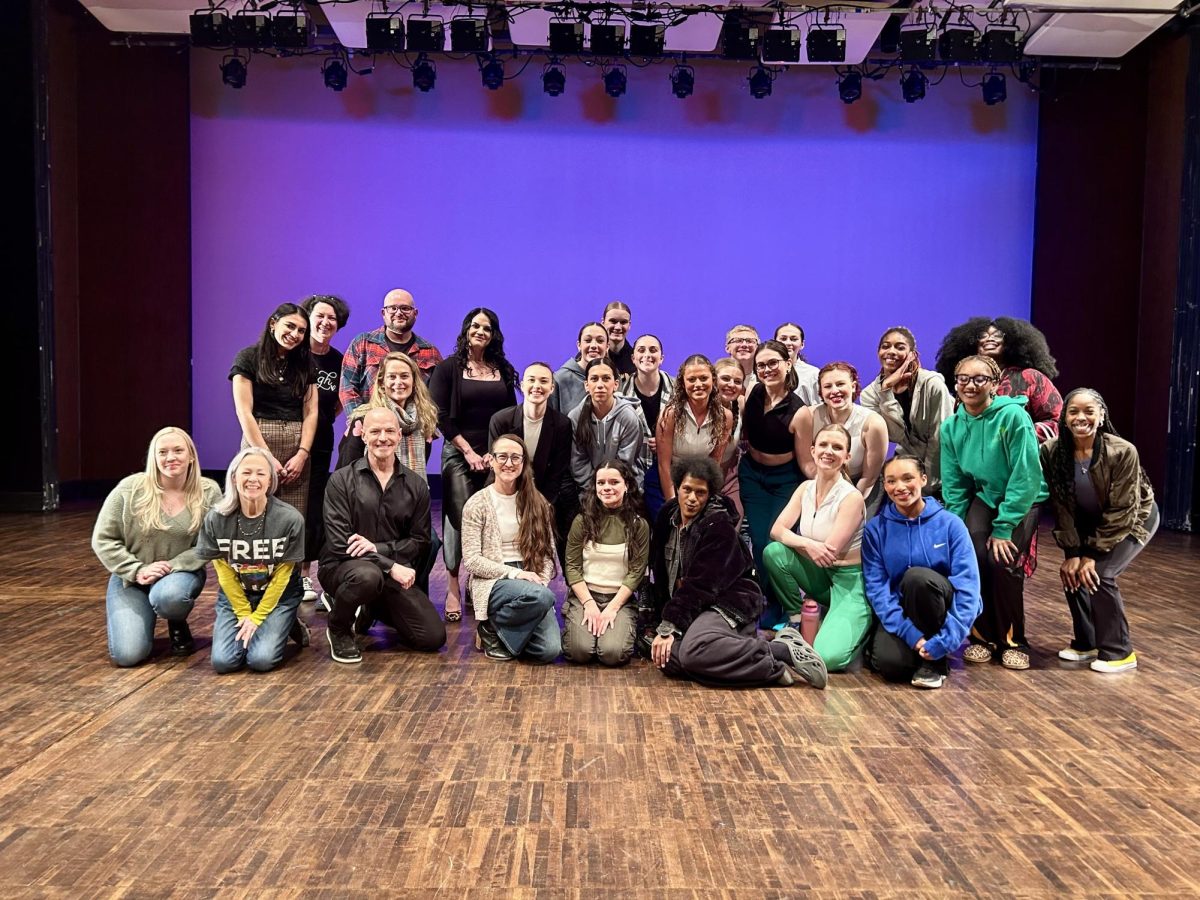
After the inaugural staging of the new “Movement & Meaning: Queer Stories in Motion” dance performance on March 23, the event organizers reflected on the cathartic process of translating LGBTQ+ mental health challenges into movement and healing.
A collaboration between the Department of Counseling and the Department of Dance reflected the long history of creative arts as healing, which is not often talked about for queer communities, Michael P. Chaney, professor at the Department of Counseling, explained.
“Mike is from the counseling department and he came to us in the dance department with this idea to find a way to display mental health topics that — transcend every human being — but specifically talking about how they affect the LGBTQ+ community,” Teresa Muller, special lecturer in dance, said.
Stemming from the Pride Project, an advocacy initiative to educate students about queer mental health issues, the performance was put together by a team of master’s in counseling students and student choreographers. Centered around four main issues, the counseling students put together presentations on anxiety, societal pressure, substance use and suicide, to which the dance students illustrated risks, resilience and protective factors.
“All the dances, I feel like, you could just get a story out of them, of being pushed away or excluded or looked down on for certain reasons,” Rachel Gralewski, a first-year counseling student, said. “But then there were also aspects where they had other people that supported them.”
With the interpretive dance pieces following speeches on the metrics and stories of mental health, the audience and collaborators experienced the intertwining of mental health and art, which many described as healing.
“The choreography team did a wonderful job and we were all very much on the same page,” Elizabeth Mance, a master’s in counseling student, said. “It was really cool watching how powerful and passionate the dances with no words behind them were, and how well they conveyed the message that we were both trying to convey.”
Heterosexism, oppression and transmisia were the epicenter of one of the most applauded performances of the night, choreographed by OU student June Wallace. With both teams of students meeting only at the performance on March 23, the counseling students highlighted how well their dance counterparts translated their research into art.
“It really was their own artistic interpretation, but especially June’s dance, I thought was amazing,” Kelly Frank, graduate student in the clinical mental health counseling program, said. “They used a jacket as a prop in the dance. I want to say it was a jazz-inspired piece. The prop, the jacket, was this element within the struggle and also powerful visually. So I think that piece in particular and really all of them translated really well, and they all had their own expression.”
Lived experience also became part of the research team as they assembled the speeches that would inform the performance.
“It pulled from my experience in counseling people, because I am working on my limited license, so I have a number of clients who are LGBTQ+,” Deanna Synowiec, a Ph.D. student with a master’s in clinical mental health counseling, said. “My research was real, lived experience, looking at and listening to and holding space for my clients who’ve experienced marginalization, minority stress, which is what our topic was about.”
With statistics turned to movement and testimonies into performance, many of the participants highlighted the event as a catharsis that captured the meaning of community and healing.
“As a member of the LGBTQIA+ population who has dealt with many of these issues, I felt seen,” Rishika Paruthi, first-year master’s student in the counseling program, said. “I found myself teary-eyed watching the dances. They really showcased the reality of mental health, which can be hard to state in words.”
For the dance department, which has hosted pride events for the past six years, the novelty came in students leading the choreography of the performance of 15 students, one of the largest groups seen in an open production. The project builds on a continuous need to foster inclusive, accessible and safe spaces for the queer community, Muller explained.
“One of the reasons why I started doing what I do in the dance program was really for comfort and just having something that wasn’t there when I was their age,” Muller said. “I didn’t have a queer faculty member, somebody to look up to when I was having whatever experiences.”
Alongside his collaborator, Chaney reminded students that the School of Education and Human Services has a free counseling center for all students and community members who want to talk about their mental health.
“I would also add for people who may not be ready to talk about things or may not be comfortable with one-on-one talking, there are ways to engage in healing and therapy that don’t involve talk, like dancing and movement and art and, you know, reading and just creating,” Chaney said.