From helping with their medical school application to strengthening family ties, students attested to the personal and professional enrichment multiple languages bring to Oakland University. During the 17th celebration of the “Nuestras Voces” publication, the department of modern languages celebrated this year’s poetry and prose journal issue, highlighting the importance of bilingual careers.
Translated to “Our voices,” the language magazine features student works from amongst the most dedicated and intentional in the academic year. The literary night on March 25 celebrated over two dozen students and their linguistic journeys.
“Nuestras Voces provides a vital platform for student creativity and self-expression,” Cecilia Saenz-Roby, Spanish professor and event organizer, said. “Through their writing, students reflect on their emotions, concerns and aspirations, often finding a sense of catharsis in the process.”
With faculty and family members invited to the event since 2010, students deliver excerpts from their works to show their language skills and open a window to their experience. From diverse backgrounds, the occasion brought together recent graduates and even a high school student who reinaugurated the German section of the publication this year.
“I’m actually a dual enrollment student… I finished the German curriculum at my high school and then I got a four on AP German,” Eliza Pizzuti, a high school senior, said. “I didn’t want to stop because I want to do German when I go to college.”
Taking language classes at OU, Pizzuti also took advantage of courses given in the target language like a German culture class and World War II. She highlighted that dual enrolment programs are just as important as entry-level courses to ensure continuity for language learners.
“I think there’s a lot of different curriculum that, you know, OU offers and in collegiate language learning that just isn’t available anywhere else,” Pizzuti said. “It’s a really unique privilege to learn about these things that I wouldn’t be able to otherwise in a language that I’m passionate about and a language that will build a skill that I can use in my future.”
The polyglot event featured works in prose and verse in Spanish, French, German, Chinese and Japanese. These are selected from a competition in the fall and are later workshopped alongside professors to produce the magazine.
“Publication also serves as a valuable credential for graduate school and job applications, as it demonstrates advanced proficiency in a second language,” Saenz-Roby said. “For the department, Literary Night is the highlight of the academic year. It showcases students’ passion for languages and cultures while inspiring them to continue their studies.”
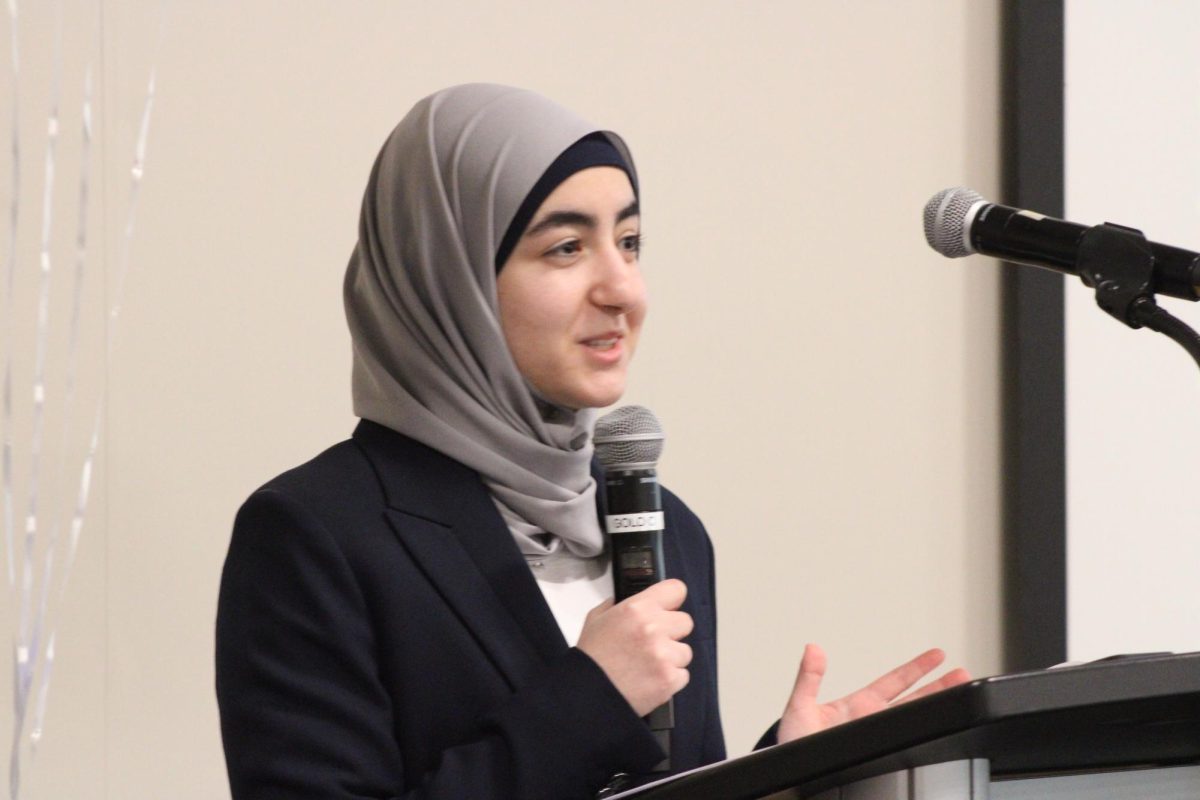
Students, like the recently graduated Ayah Neiroukh, explained how language classes allowed them to advance academically and connect in the community.
“I was also nominated by the Spanish department for the meritorious achievement award, which had me speak at graduation and [it’s] something I’m very thankful for and I will never forget, really,” Neiroukh, a soon-to-be medical school student, said. “So Spanish was a huge part of my application to medical school as well and I was asked about it in several of my interviews.”
From a Spanish-only publication in 2009, Nuestras Voces is looking to expand to Arabic next year as the Department of Modern Languages undergoes a revamp in its class offerings.
“In the College of Arts and Sciences, we believe deeply in the importance of communication, creativity and cultural understanding,” Kristin Landis-Piwowar, Vice Provost for Academic Affairs, said. “Nuestras voces embodies all three. It reminds us that language is not just something that we learn, it’s something we live, we use to connect and something we use to tell our stories.”