Following the recent strikes on Iran, President Donald Trump has been looking for allies to add alongside partner Israel.
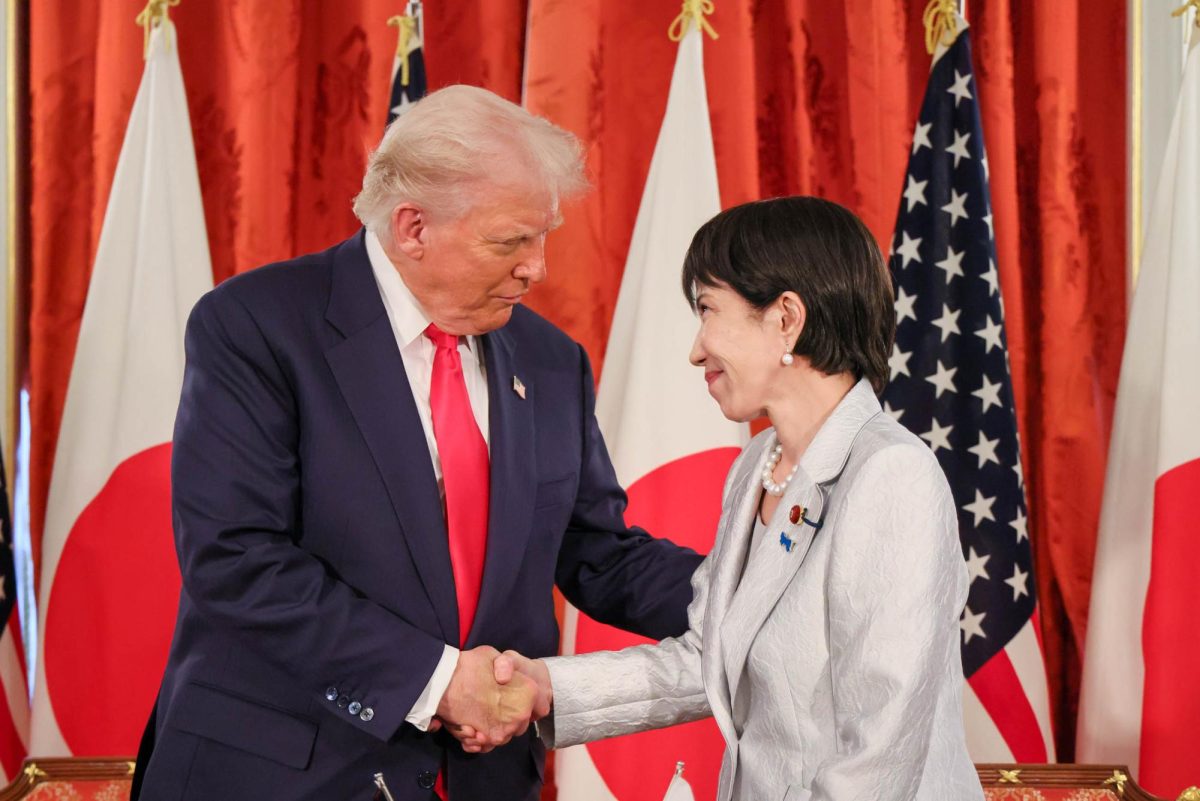
On Thursday, March 19, Japan’s first female prime minister, Sanae Takaichi, was invited to the White House to improve Japanese and U.S. relations.
This invite falls during the famous Cherry Blossom time in Washington D.C., commemorating the very gift that Tokyo Mayor Yukio Ozaki gave to the city of Washington D.C. in 1912 as a symbolic way of creating a firmer friendship between the U.S. and Japan.
Relations with Japan—as of late—have been very good, as President Trump reportedly said that he would help Premier Takaichi with “any favor” she may need. He also mentioned that the two of them had become “very close friends” and added that Takaichi “is a winner.”
While meeting, Premier Takaichi and President Trump discussed the ongoing conflict in the Middle East, specifically with the U.S. and Israel’s recent airstrikes on Iran.
“Iran must never be allowed to develop nuclear weapons,” Premier Takaichi stated on behalf of Japan’s current position on the conflict.
As the international supply of energy begins to raise concerns among many international leaders, Japan is focusing on de-escalating the ongoing airstrikes and restoring peace in the Middle East.
Specifically, Premier Takaichi aims to strengthen Japanese and American relations to expand the production of U.S.-sourced energy by sourcing home-sourced, Alaskan oil.
The meeting can’t be discussed, however, without acknowledging the awkward moment between the two global leaders.
Following a reporter’s question regarding why the U.S. chose not to notify Japan or other countries in their decision to bomb Iran, Trump responded with the following comment:
“We didn’t tell anybody about it because we wanted surprise. Who knows better about surprise than Japan?” President Trump said. “Why didn’t [Japan] tell me about Pearl Harbor? Right?”
On Dec. 7, 1941, Japan bombed a U.S. naval station in Pearl Harbor, Hawaii, killing 2,390 U.S. military and civilians—thus officially introducing U.S. involvement in World War II.
As per the New York Times, they have reported that President Trump has begun adding pressure to Premier Takaichi’s first visit to the White House, as he wishes for Japan to dispatch minesweepers and maritime forces to help reopen the Strait of Hormuz — a waterway that is vital to the transport of goods. President Trump has pressured this summit by suggesting that the U.S. is owed at least this for the defense aid it has gifted Japan in the past.
Japan has been disturbed by the war in the Middle East due to its heavy dependence on the importation of oil from that same region. About 85% of the country’s energy consumption is based on this importation.
Premier Takaichi has been more active regarding the conflict in the Middle East, unlike her European counterparts. She has said that it would be a “legally difficult” charge to take on. She also declared that the situation in Iran is not yet dire enough, or “survival threatening,” for Japan to defensively respond.
She is still currently considering what the next steps are in de-escalating the ongoing situation.
“Regarding the ongoing tense situation in Iran, we confirmed the importance of swiftly calming the situation and ensuring the safety of navigation in the Strait of Hormuz and the stable supply of energy,” Premier Takaichi posted on social media following the summit.
Furthermore, traveling to and from Japan and the Middle East has decreased. The worst occurred on Feb 28 when all Osaka-directed flights from and to the Middle East were cancelled. Hotels are seeing a rising number of cancellations, airlines are cancelling flight trajectories and plans have led touring companies to follow suit as well.
European leaders have reportedly stepped away from the Iranian conflict. Though the proximity has pushed them to discuss the matter at a Summit in Brussels on March 20, no executive decision was made.
The conference was said to be unproductive in its 12 hours of meeting, and has left the European leaders with the ultimate reality that none will currently be capable of stepping in to intervene in either the conflict in Iran or Ukraine.
“In these very troubled moments in which we are living, more than ever it’s decisive to uphold the international rules-based order,” said European Council President António Costa, as he chaired the Summit in Brussels. “The alternative is chaos. The alternative is the war in Ukraine. The alternative is the war in the Middle East.”
The initial Iranian protests against the country’s former leader, Ayatollah Ali Khamenei, have quickly led to newer headlines of nuclear rumors in the country, and the conflict has now grown to an Israel-aided attack by President Trump, which lacks Congressional approval.
Although it has not even reached one month since the initial airstrikes, more and more players are now being invited to join, as Lebanon has restarted its conflict with Israel, and Japan might soon be persuaded into playing a part as well.