On Feb. 22, in intelligence handed over by the CIA, Mexican special operations were able to track down, capture and kill Nemesio “El Mencho” Oseguera Cervantes—one of Mexico’s most prominent cartel leaders. Cervantes was the leader of the Jalisco New Generation Cartel (CJNG), one of the country’s most powerful crime organizations.
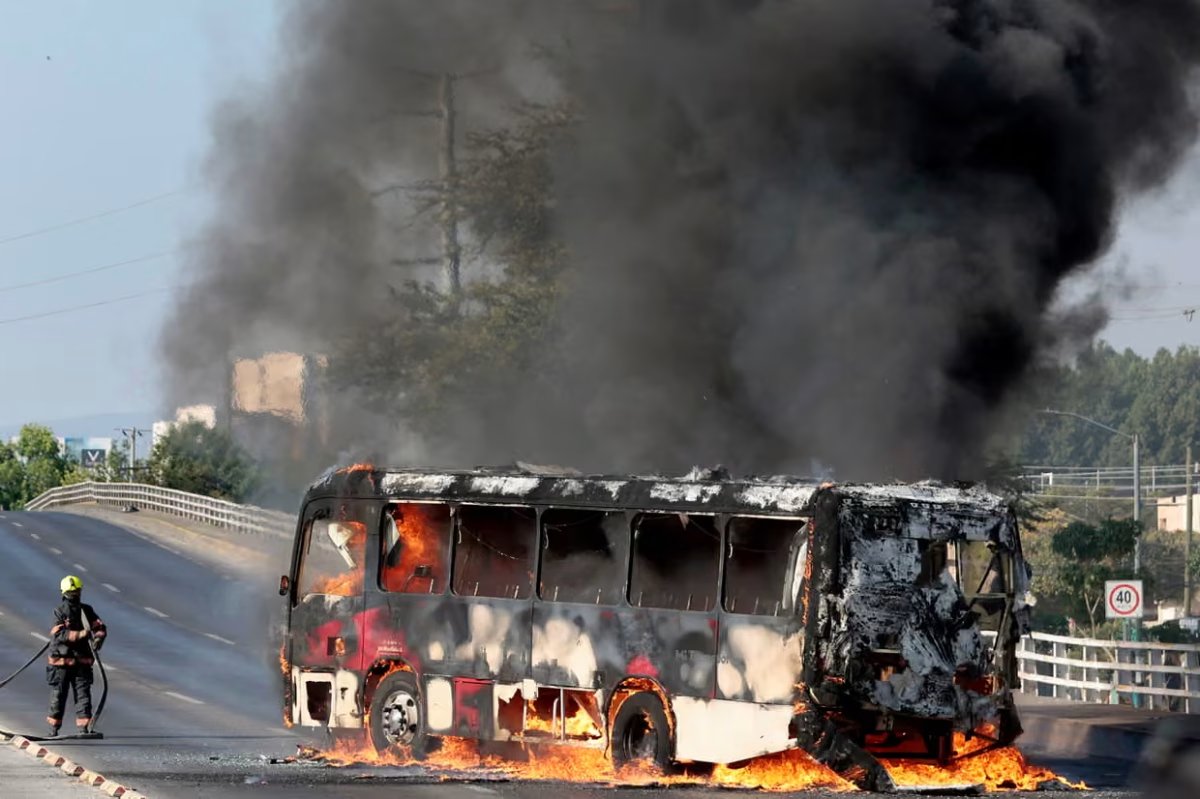
Since his killing, violence has erupted across the country, especially in the state of Jalisco. Roadblocks and fires have been reported—with videos on social media appearing of tourists being stranded in airports, unable to leave due to the ongoing violence.
Mexico-native Ana Samaniego is in her third year of psychology at OU. While she has never experienced or heard much about the narco (organized crime organization) in her home state of Querétaro, her relatives that reside in other states, such as Michoacán, have been her source of knowledge regarding the ongoing violence.
Samaniego found out about the ongoing cartel attacks from the social media app TikTok when shortly after she received a text message from her mother—who was in Querétaro after El Mencho’s death.
“My mom sent a message saying that—well she traveled to Querétaro—that they were in a mall walking around, and then they were evacuated from the plaza, from everywhere,” Samaniego said. “Classes were canceled and you don’t really hear about that kind of thing in Querétaro. So it gives you an idea of how big this was that [it] happened in other states. People were very scared; they couldn’t leave their homes.”
Samaniego’s relatives are currently safe, however those who reside closer to the affected areas like Jalisco are currently in lockdown to protect themselves. In addition, many business owners have closed their shops for several days, causing a pause in their lifestyle and income as the violence continues.
The biggest question is what comes next, and for Samaniego, she is asking what these specific plans are to protect her and her people.
“Obviously, this narcotrafficking system isn’t just about ‘catching one person and that’s it, they killed the leader and that’s it.’ It really isn’t. This is a much deeper system that isn’t just about violent aggression; it’s also a mentality, and I think this idea, for example, of narcocorridos, the narco-culture, is something else that also needs to be combated. So I’d like to know what steps are being taken, what’s next, what has improved, what’s going to get worse, or what’s going to stay the same.”
For those who reside in Mexico, such as University of Guanajuato student Francisco Centeno, that question of ‘what comes next’ can’t come any sooner. Centeno originally resides in Irapuato, an agricultural-based and historic city in the state of Guanajuato. The University of Guanajuato is located in the capital of the state, Guanajuato city, 137 miles from Jalisco but still within the CJNG’s reach and a contested ground for warring cartels.
He and other citizens in Guanajuato first heard of the capture of El Mencho along with a wave of uncertainty as to what was currently ensuing. Accounts of misinformation created a “great deal of fear” among his fellow students and his family.
“At that moment, I was outside walking down the street on one of my usual routes—and I didn’t know about the chaos happening in Jalisco, nor what had happened in my hometown, since in a neighborhood across the street from where I currently live—about a kilometer away—fires were started where arson was commited against commercial establishments,” Centeno said.
It wasn’t until the community as a whole started reacting that Centeno realized the urgency and magnitude of the situation.
“I didn’t find out until almost three hours after the events—that everyone was hysterical, so to speak; the buses stopped running, my family’s phone kept ringing and it was at that moment that I realized the seriousness of the matter,” he said.
“I also found out that in the city where I study [Guanajuato], which is very different from my hometown, commercial establishments have been burned down in the downtown area, which is the most important tourist area in my state,” Centeno said.
The downtown of Guanajuato city contains complex road-route systems, according to Centeno, that are difficult to navigate through unless in a vehicle. With that being said, it makes it easier to block-off and catch criminals in dead-ends of the city, which is what happened to the arsonists who burned down the commercial establishments.
There have been narco-related attacks in the past, such as in Culiacán with the arrest of major narco-leader El Chapo’s son, in which its effects reverberated across the country. The current attacks, however, aren’t the first time that something from a national level has affected Centeno and Guanajuato to such a degree.
In 2021, one of Centeno’s classmates was killed by the National Guard who were patrolling the area following the capture of Santa Rosa de Lima cartel leader José Antonio Yépez Ortis, known as “El Marro”.
The Centeno family has faced their own pain from narcoviolence.
“The narco isn’t something that runs in my family, so to speak, in the sense of a family member being involved. However we have had many encounters with an extension of narcotrafficking, the narcoviolence. I have relatives from a rural community in a place called Aldama who suffered the disappearance and subsequent discovery of a cadaver of one of our family members. This isn’t exactly immediate family, but because they are extended family who knew immediate family, it did affect us,” he said.
His family now resides in the U.S.
“Regarding our migration to the United States, it was partly driven by narcotrafficking but it was, so to speak, the third reason out of five. The main reason we decided to stay [in the U.S.] was precisely to give my sister a slightly safer environment to live in and not to be under, so to speak, the uncertainty of drug-related violence here in Guanajuato.”
Centeno, like many others, quickly learned that it wasn’t just El Mencho who was captured, but many other high-ranking members of their cartel as well. As he and many professors have analyzed, this may just be the beginning, not the end.
“It’s very likely that more than one of my classmates, a very, very large generation of young people, who have this ease, so to speak, of being from a middle-class background, can leave the country” he said. “I think it’s very likely that they will.”
However, that will depend on how much the government chooses to intervene, and what tactics they choose to take to combat these ongoing and generational issues.
For the time being, citizens will have to continue their daily routines if that means they want to be able to provide for themselves and their families.
“This is now a matter of personal ideology,” Centeno said. “So, despite the violence that has been going on for many years, despite a relative economic boom, the people on the streets, the ordinary people, can’t be intimidated. Because putting food on the table doesn’t come easily, right? We cannot let ourselves be defeated by fear. And likewise, fear does not govern those who are in need of work, but we should have much more regulation, much more security from the relevant authorities so that ordinary people, the common people, can carry out their necessary activities with relative safety, integrity, decency and without being affected by violence.”
As both Samaniego and Centeno have said, exterminating a cartel isn’t as easy as it may seem. And for the Mexican government, they have been struggling for decades.
As said by Professor Cristian Cantir, Associate Professor of OU’s political science department, the narcos are “complex and powerful institutions” due to their heavy artillery and financial stability. As a result, this even allows them to “overwhelm” police and military forces.
Cartels are able to gain more members by targeting vulnerable, often impoverished, citizens. They offer opportunities to take work in other countries that are struggling with poverty and underdevelopment, thus using a weak justice system to utilize their ability to corrupt communities and gain profit. These jobs are mostly illegal work that often involves trafficking drugs and artillery.
The recent events following the killing of El Mencho are an example of the struggles a sovereign state has in effectively and peacefully rid themselves of the complex criminal organizations, according to Professor Cantir.
For what he believes may happen next—based upon historical examples and scholarship on the topic—the ongoing power struggle between the government and the cartel will lead to further violence and instability within the country.
“The government in Mexico is inevitably aware of this issue, and I hope they have a strategy for dealing with the consequences,” Professor Cantir said. “Simply taking out leaders of cartels isn’t a coherent and long-term recipe for success; that approach has to be part of a broader and multidimensional policy to deal with root problems that facilitate the continuing existence and success of cartels, as experts from the International Crisis Group, for instance, have asserted repeatedly in the past.”