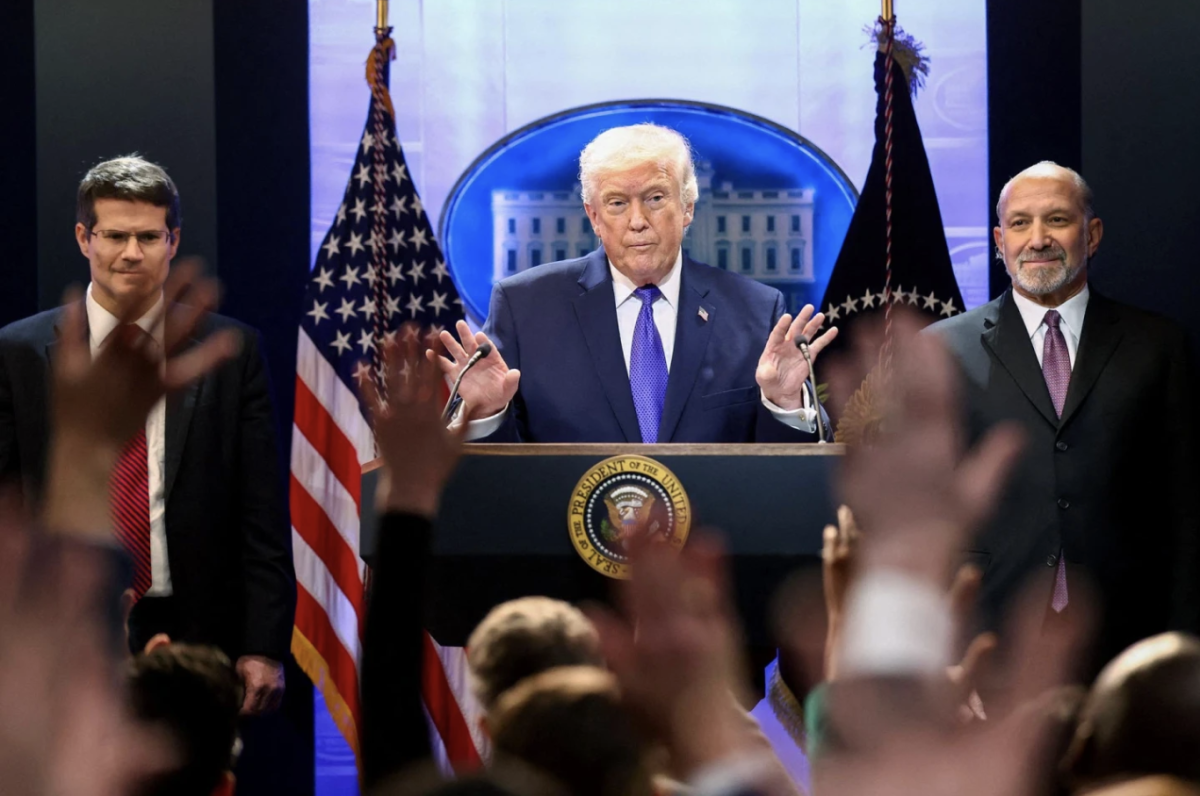
Earlier in the weekend, the Supreme Court held a ruling over President Donald Trump’s infamous tariffs.
The Supreme Court’s ruling occurred on Feb. 20 and ruled that the President overstepped his authority when he applied his powers to nearly all the international trading partners the U.S. has.
The ruling is now being recognized as the 6-3 decision. It has already created incredible uncertainty in the short time of its existence for the Trump administration’s economic agenda.
“No one can deny that the president’s use of tariffs has brought in billions of dollars and created immense leverage for America’s trade strategy and for securing strong, reciprocal America-first trade agreements with countries that had been taking advantage of American workers for decades,” Speaker of the House Mike Johnson said. “Congress and the administration will determine the best path forward in the coming weeks.”
The Trump administration was first able to apply the high tariffs, which have sent many European allies scrambling to create new deals, at the beginning of his second term. The tariffs became an incredibly popular topic of conversation that all were focused on.
President Trump was the first president to enact the tariffs without congressional approval, by using the 1970s emergency statute and IEEPA, a sanctions law, to allow him to raise the tariffs to a percentage never seen before.
With the 6-3 decision ruling, consumers will see an effect on their own daily lives. Americans are predicted to see a decrease in all imported goods, which have recently seen an intense increase in pricing. Products such as retail, beauty products, electronics, furniture, perfume, household appliances and more will have more affordable prices.
The tariffs so far have given a collection of over $200 billion since the beginning of 2025. President Trump has already spoken about trying to find a way to “work around” the new impediment of the Court.
“Their decision is incorrect,” President Trump said. “But it doesn’t matter because we have very powerful alternatives.”
The president has already responded to the Court’s ruling with a new pledge to apply a new 10% tariff to all imports, the protection of a law which holds no connection with tariffs.
Europe, which will be most affected by this continued decision of adding tariffs, had Olof Gill, the European Commission spokesperson, make the statement.
“We remain in close contact with the U.S. Administration as we seek clarity on the steps they intend to take in response to this ruling,” Grill said.
President Trump further lamented the decision of the Supreme Court by arguing that it was too polarizing a discussion to be having.
“What happened today never seems to happen with Democrats. They vote against the Republicans, and never against themselves, almost every single time, no matter how good a case we have,” he said.
In response, some Republicans were seen celebrating along with Democrats after the ruling was announced. Senators such as Chuck Grassley (R-IA) and Mitch McConnell (R-AL) were reported as saying that President Trump’s acts were “illegal.”
“Congress’ role in trade policy, as I have warned repeatedly, is not an inconvenience to avoid,” Sen. McConnell said. “If the executive would like to enact trade policies that impact American producers and consumers, its path forward is crystal clear: Convince their representatives under Article 1.”
Additional negotiations are sure to follow; the federal government may try to rein in Trump’s additional 10% tariffs. If they, however, do see the light of day, we can expect our European allies to keep fighting for them to be lowered or eliminated, just as they have been.