


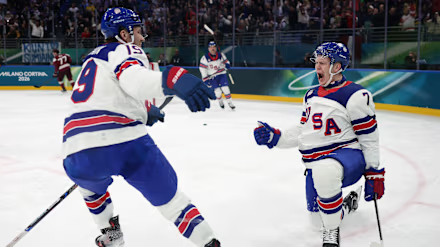
The U.S. men’s Olympic hockey team has started the 2026 Winter Olympics on a strong note, asserting itself as a serious contender for a medal in Milan-Cortina.
With NHL players back on Olympic ice for the first time in 12 years, expectations were high, and through the preliminary rounds, the Americans have delivered results that justify the optimism.
The tournament opened for Team USA on Feb. 12 with a convincing 5-1 victory over Latvia. In that game, the Americans quickly took control, outshooting their opponents and showcasing balanced scoring.
Brock Nelson led the attack with two goals, while Jack Hughes contributed two assists, underscoring his return to full health after a brief injury absence. Despite having a couple of early goals disallowed in the first period, the U.S. dominated possession and was the better team across all three periods.
Two days later, the U.S. faced Denmark in its second preliminary match and again emerged victorious with a 6-3 win. Denmark grabbed an early 2-1 lead, surprising many viewers, but the Americans responded emphatically.
Jack Eichel’s goal and assist helped spark the comeback, and the scoring was distributed across the lineup. Brady Tkachuk, Matt Boldy, Noah Hanifin, Jake Guentzel and Hughes all found the back of the net, highlighting the depth and versatility of the roster.
That 2-0 start gives Team USA six points atop Group C with one preliminary game remaining, putting it in a prime position to secure a top seed entering the knockout stage. According to USA Hockey’s official schedule, the final group game for the Americans will be against Germany on Feb. 15 at 3:10 p.m. ET. A win in that contest would cement a perfect 3-0 record in group play and likely earn the U.S. a bye into the quarterfinals.
Despite the strong start, the road ahead won’t be easy. Germany has been competitive in this tournament, and its ability to challenge top opponents suggests that America’s final group game will be a meaningful barometer of its medal prospects. The Germans’ more structured defensive play and experience at international events make them a tougher matchup than the previous two opponents.
Looking beyond the preliminary rounds, the Olympic schedule is daunting but promising for the U.S. Should it advance, the team will proceed to the playoff round and, if successful, into the quarterfinals, semifinals and ultimately a chance to compete for the gold medal on Feb. 22. With NHL talent on the roster and offensive firepower spread throughout the lines, the Americans have the tools to go deep into the tournament.
One of the narrative threads of this year’s Olympic hockey story is the return of NHL players to the international stage. This restored level of competition favors teams like the United States, whose roster boasts active NHL stars.
Many of these players — like Hughes, Tkachuk and Nelson — are not just skilled but battle-tested in high-stakes environments, making them valuable assets as the tournament intensifies.
While early victories are crucial for momentum, they are also a reminder that this team still must prove itself against elite European competition. Canada, Sweden, Finland and other traditional hockey powerhouses have maintained strong performances in Milan-Cortina, each posing a unique tactical challenge. As the group stage concludes and the knockout rounds begin, coaching decisions and line management will become even more critical.
For fans and observers, the most exciting aspect of this year’s U.S. team is the combination of established stars and emerging talent stepping up on the Olympic stage. If Team USA can sustain its current play, limit costly mistakes and capitalize on scoring opportunities, a medal — and perhaps even gold — remains within reach.