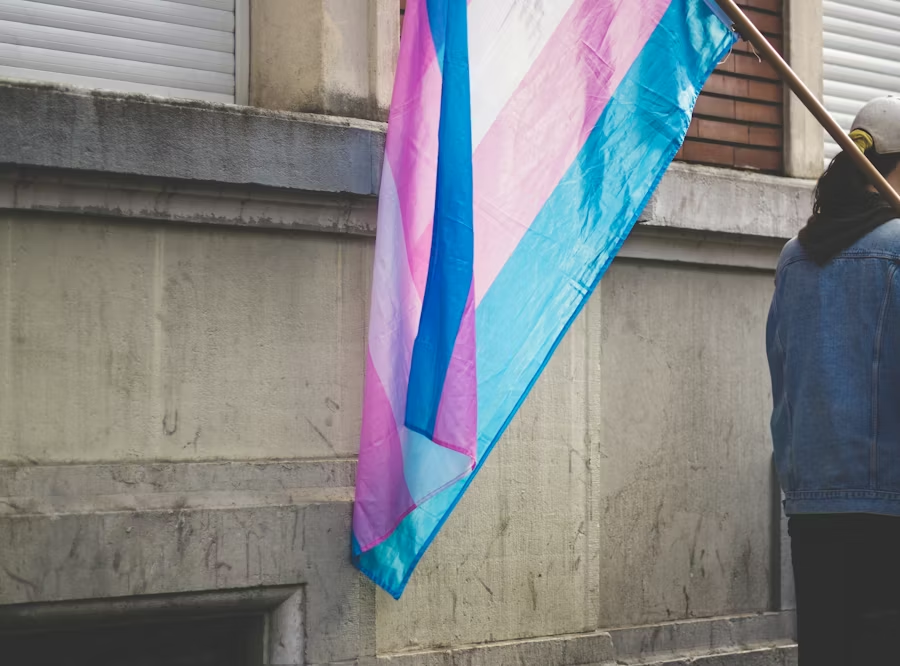
When the National Collegiate Athletic Association updated its transgender student-athlete participation policy in early 2025, it reignited a national debate over fairness, inclusion, and federal civil-rights enforcement under Title IX, an issue that continues to shape college athletics across the country. Title IX is a landmark federal civil rights law in the United States that prohibits sex-based discrimination in any education program or activity that receives federal funding. Passed as part of the Education Amendments of 1972, its core purpose is to ensure that all people have equal access to educational opportunities, regardless of their sex.
On Feb. 6, 2025, The National Collegiate Athletic Association (NCAA) Board of Governors adopted a policy limiting competition in women’s sports to student-athletes assigned female at birth. Athletes assigned male at birth may still practice with women’s teams and receive team benefits, but they are barred from competing in women’s NCAA championship events. The policy applies to all NCAA member institutions, representing more than 1,100 colleges and universities nationwide.
NCAA President Charlie Baker said the change was intended to provide consistency amid growing legal uncertainty. “We strongly believe that clear, consistent, and uniform eligibility standards would best serve today’s student-athletes instead of a patchwork of conflicting state laws and court decisions,” Baker said. The policy followed Executive Order 14201, titled “Keeping Men Out of Women’s Sports,” signed in early 2025. The order directed federal agencies to enforce sex-based participation standards tied to Title IX and linked federal funding to compliance, prompting athletic governing bodies to revise existing guidelines.
Federal enforcement actions soon followed. In January 2026, the U.S. Department of Education’s Office for Civil Rights (OCR) ruled that San José State University violated Title IX by allowing an athlete assigned male at birth to compete on the women’s volleyball team and access women’s facilities. “SJSU caused significant harm to female athletes by allowing a male to compete on the women’s volleyball team, creating unfairness in competition, compromising safety, and denying women equal opportunities in athletics,” said Kimberly Richey, Assistant Secretary for Civil Rights. “We will not relent until SJSU is held to account for these abuses and commits to upholding Title IX to protect future athletes from the same indignities.”
The OCR also criticized the university’s response to athlete complaints and outlined corrective actions, including restoring lost competitive opportunities and adopting sex-based definitions under Title IX. Beyond San José State, federal scrutiny has expanded. The Department of Education has opened many Title IX investigations into athletic associations and institutions nationwide, signaling increased oversight of transgender participation policies.
Reactions within the sports community remain divided. Some athletes and advocates argue the NCAA policy protects fairness in women’s sports, while others say it risks excluding transgender athletes and oversimplifying complex questions of equity and inclusion. Legal challenges are also emerging. In one case, a transgender runner sued Swarthmore College over the application of the NCAA policy, highlighting unresolved legal questions surrounding Title IX and gender identity in athletics.
As courts, federal agencies, and athletic institutions continue to weigh competing interpretations of Title IX, the future of transgender participation in college sports remains uncertain.