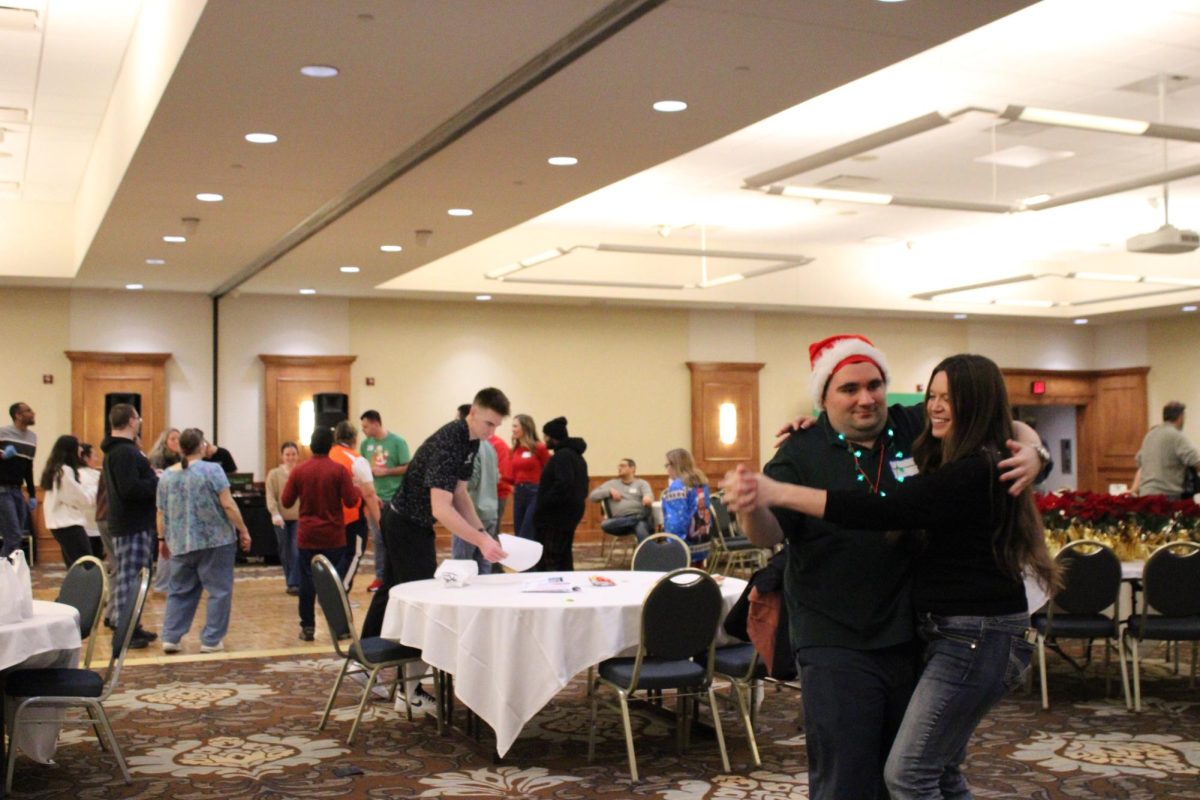
With karaoke, boardgames and dancing, the Joanne and Ted Lindsay Foundation Autism Outreach Services (OUCARES) hosted a Holiday Party on Jan. 17 to celebrate the autistic community at Oakland University. Now a tradition for OUCARES, the occasion drew new volunteer participants and returning visitors from Lansing and Ann Arbor.
“We’ve been having it for over 10 years,” Kelsey Kobylarek, OUCARES facilitator and coordinator, said. “A good portion of people are returning people too, so it’s their tradition to come to this every year. They’ll be calling months in advance, reminding us that we are having the event.”
Since 2004 — as part of the OU Center for Autism — OUCARES has provided outreach services, social groups and learning programs for the autistic community. From 20 families in the early 2000s to over 2,000 participants last year, OUCARES has created a growing home for kids, teens and adults of all ages.
“We’ve had a lot of the same facilitators and coaches for as long as the participants have been participating,” Kobylarek said. “[Participants] have been coming to this program for 20 years, you know? So it’s just their life and their routine, but I think that’s what makes it so special, is that we’re a home base for a lot of people.”
With over 60 participants attending the event, OUCARES provided new and familiar activities for decade-long friends and fresh faces in the programs.
“I came to have a great time, to party,” Haile Reime, OUCARES participant, said. “I used to do the training program for employment, to help you get jobs.”
Like Reime, a majority of the attendees were autistic adults who met in the teen or adult groups. Mixing life skills and hobbies, these range from basketball and gaming to cooking and social connections workshops, fostering a holistic sense of community. With new initiatives each year, like the Women on the Spectrum Connect program or the athletic club, OUCARES has been working to meet the needs of all members.
“It makes me feel like I’m unique and special in my own way,” Reime said. “Just embrace it and enjoy life and have fun.”
Katie Oswald, facilitator of the skills for healthy relationships program, highlighted the importance of having the voices of people on the autism spectrum at the forefront of the conversation. With that goal in mind, she attended the celebration as part of the Full Spectrum Agency for Autistic Adults (FSAAA).
“I also lead Full Spectrum Agency for Autistic Adults. It’s an autistic led nonprofit and we’re doing a survey designed by autistic people, for autistic people,” Oswald said. “We’re working with the Michigan Autism Council, so we want to get as many responses as we can so that autistic voices are being heard at the state level.”
Launched at the end of 2025, the survey is expected to run for a year across the state, for the first time, to enrich and inform the insight behind support groups and resources for the autistic community.
“For a long time, a lot of the decisions have been made about autistic people without hearing from us and what we really need,” Oswald said. “People are hearing from a lot of clinicians, educators, practitioners, parents and those perspectives are important as well, but it’s not as important as making sure that we’re hearing from autistic people when we’re making decisions about us.”
Under the slogan of “nothing about us without us,” Oswald and FSAAA have created spaces for people who have felt isolated, who are looking to unpack trauma and foster a community advocating for their needs.
“It’s really important for people to understand that it’s not something that’s broken about us, it’s not something that needs fixing,” Oswald said. “Yes, it does come with its own set of challenges that we need support with. So the support we need might be a little bit different than what’s expected, but we don’t need to change who we are.”
As the event came to a close after karaoke, attendees highlighted the importance of community building through inclusion. Unanimously, volunteering was the number one way to support those efforts.
“There are allistic people involved in this and there are probably people who get involved in this that have never interacted much with autistic folks before,” Oswald said. “That’s how we get to acceptance, by getting together in spaces like this.”
For more information about OUCARES, please visit oakland.edu/oucares/.