A wretched old man filled with hot coals of malice where the warmth of holiday should be. A curmudgeon haunted by spirits of the past, present and future to show him the error of his ways. A last-minute turnabout—of the sort the world keeps waiting for Jeff Bezos, Elon Musk (and the absolute grumpiest fathers) to undergo. All wrapped in gilded mistletoe, draped in ribbon—with a Victorian backdrop.
Since its original publication in 1843, Dickens’ “The Christmas Carol” has enjoyed a prolific impact upon the cultural canon. To call it a classic is unfair, it is something more akin to a modern myth.
Scrooge and Tiny Tim have become archetypes within their own right. To cast the characters correctly is a tall order—it is a real shrew to tame.
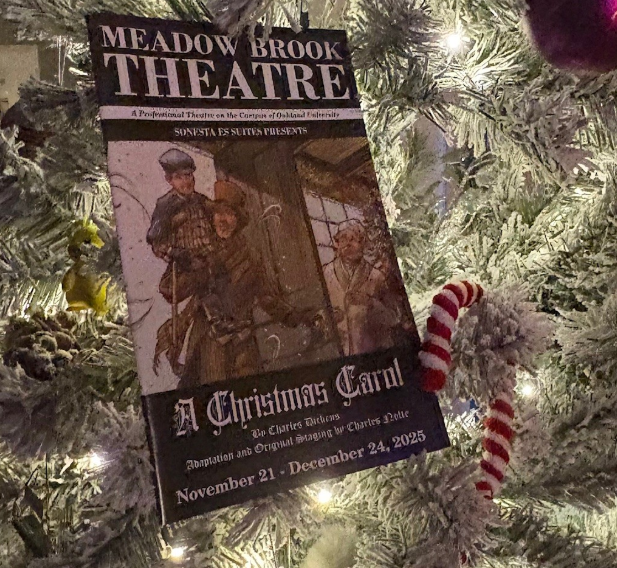
Meadowbrook Theatre’s 43rd anniversary production of The Christmas Carol does a truly prolific feat then. It captures the magic of the classic story—while demonstrating true Broadway-level discipline, theatrics, special effects and quite a bit of the Christmas spirit.
The play opens with renditions of period-appropriate carols with explanations of their origins. A lovely yuletide twists to the recent trend of deep dives into Victorian nursery rhymes. The carols themselves were performed with both talent and passion.
The play itself is even more impressive than its pleasant opening. One is immediately wowed by the outfits and hair. Flowing topcoats, burling dresses, hair defying gravity and basic time management—the whole nine yards. The actors were so accurate they were still wet from the ink from Dickens’ quill.
Meanwhile, the set flowed like a dreamscape. Ghosts and specters emerge from tile forms. Their haunted forms pulling rattling chains from Hell itself. A true spectacle. Not only was Scrooge (Phil Powers) afraid of Jacob Marley’s (Anthony Guest) macabre postmortem physique, but Marley and the special effects team successfully managed to scare the audience at least a couple of times.
Tiny Tim (depicted by both Russell Clauser and Robert Spiro, depending on day) was another highlight of the performance. The cuteness, aggression and pity experienced by the audience were palpable, which is the exact Dickensian role of the character.
Scrooge’s interaction with the Ghost of Christmas Past (Maya Magyari) brought a tear to my eye. The magic of sentimental colored lighting and her gentle presence make it easy to erupt from nostalgia of Christmas before lifespan moral injuries. Enough to remind a somber critic that the nostalgia root is in the ancient Greek language—its ancient meaning being pain from an old wound.
To pry any deeper into spoilers would be a disservice. Any reader ought to utilize their student discount and be a patron of the arts. Any non-student reader should consider paying full price for this play. This is truly Broadway level production at college theatre prices.
The ghosts do steal the show. All of them. They steal the book too—this is a fair adaption of the source material, but the use of modern theatre magic is truly impeccable here. The set, costumes and sound design of the entire play are impressive. However, the ghosts utilize all of these to an extent better than sometimes seen at the highest level of professional production. It truly is special.
Had I not walked into that theatre and seen it for myself—I would have a truly challenging time believing that theatre of that level is put forward on a college campus.
That is not meant as a slight at college theatre—it is rather meant to say that shy of going to The Guthrie in Minneapolis or The Old Vic in London, one would find themselves most pressed to find a more impressive production of a Christmas Carol.
Seriously, go see it. All you will want for Christmas is for 3,000 of those phantasms to be unleashed upon the most miserable and greedy.
Five candy canes out of five.
And zero bah humbugs.