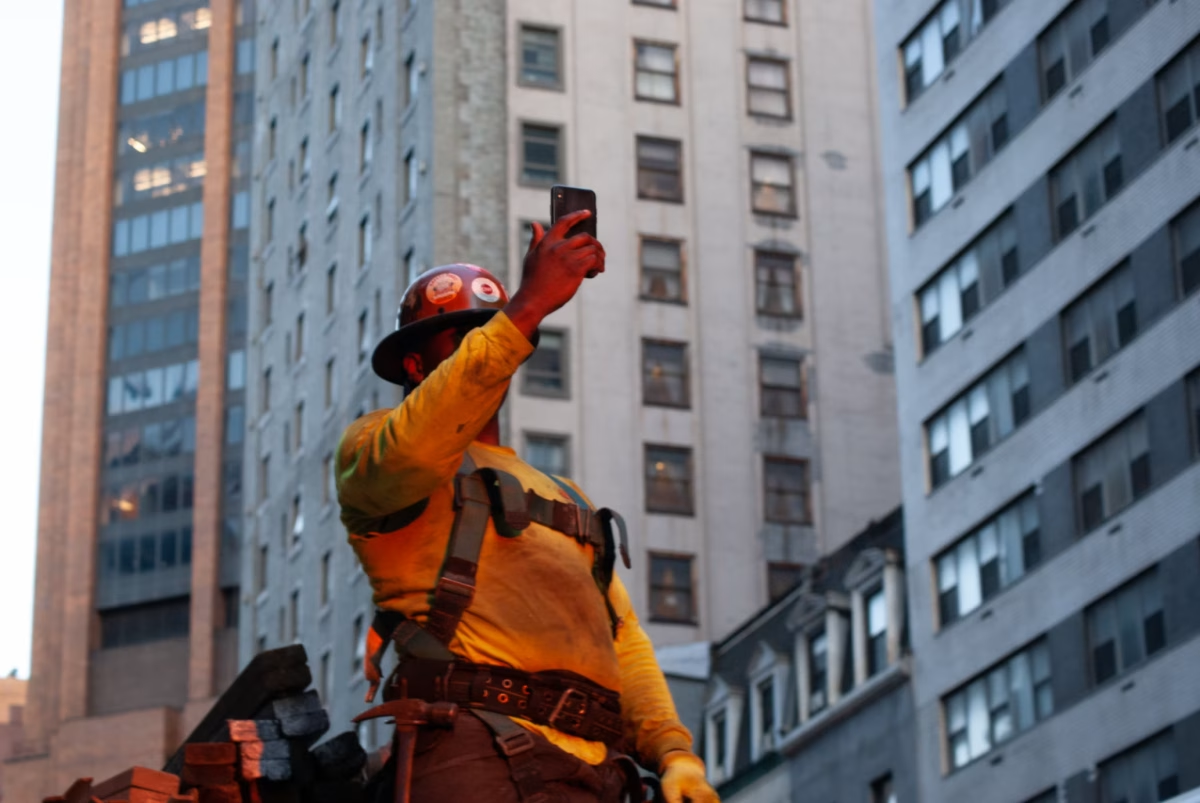
On Wednesday Nov. 12th, City Bureau, a Chicago-based journalism lab, hosted a Network CoP to give citizens the tools to document U.S. Immigration and Customs Enforcement (ICE) activity.
In the workshop, held between 6:30 p.m. and 8:30 p.m. CT on Zoom, attendees learned about the tactics being used by immigration enforcement officers to intimidate communities and best practices for surveillance.
City Bureau, a Chicago nonprofit newsroom, envisions a future of civic journalism, where all people can gain the tools to hold local government accountable. In 2016, it launched Documenters — a nationwide partnership with other newsrooms that trains and pays people to take notes on meetings that occur in their townships.
These documents are then published on the Documenters.org website, where they become open-access resources for the community and can benefit local reporting. Since its founding, the program has hired over 4,000 people from 16 states and recruits new members throughout the year at its quarterly orientations.
Chicago has witnessed over 600 new recruitments since early Sept. when the Trump administration announced Operation Midway Blitz — an immigration crackdown said to target undocumented individuals with criminal histories.
However, the number of those arrested with criminal charges or convictions has been declining since April. Instead, people with civil immigration violations—a term used to describe actions like overstaying a visa or crossing the border illegally— now represent the largest group taken into custody by ICE.
On the Nov. 12 live training on Zoom, Documenters learned about the scope of agencies acting under the Department of Homeland Security (DHS). During the 2-hour session, members gained the tools to monitor ICE activity; they were then introduced to the process of creating reliable visual and legal records of abuses committed by agents.
Before diving into the segment “How to Document Immigration and Law Enforcement Activity,” panelists provided insight into certain tactics ICE agents use to facilitate arrests.
On Jan. 21, 2025, the Trump administration declassified sensitive locations—schools, hospitals, and houses of worship —as spaces protected from ICE operations. Although private spaces like residences or ‘Employee Only’ zones require approved search warrants to enter, ICE agents often “mislead” or “misidentify” themselves to gain access.
In Aug. 2025, a settlement to a lawsuit challenging ICE’s home arrest practices in Los Angeles—first issued in 2020 —was approved by U.S. District Court Judge Otis D. Wright II of the Central District of California. It sought to prohibit ICE from misrepresenting their identities or the purpose of an inquiry, necessitating that they first identify themselves as members of the agency.
However, Viri Martinez of the New Jersey Alliance For Immigrant Justice, noted that agents often identify themselves as members of local law enforcement when they show up at a person’s door or try to push through, compelling the resident inside to let them in. In some cases, they may even purport to have a judicial warrant for a search.
During her segment on “An overview of ICE, CBP, and your rights”, Martinez encouraged people to invoke their Fourth, Fifth, and Sixth Amendment rights if approached by an ICE officer: these afford them protection from unlawful searches and being pressured to disclose information.
Martinez explained that instead of opening the door, a person should first ask agents to identify themselves and request that the warrant be slipped under the door to validate its authenticity. She also screen-shared pictures of documents to help participants distinguish between judicial warrants and ICE-signed warrants. A valid judicial warrant, Martinez said, must be signed by a judge and officialized by the U.S. District Court: An ICE warrant, however, is issued by ICE or DHS and does not permit an officer to enter a home.
Christian Aldana, Learning Manager of Detroit Documenters, discussed how people can protect themselves and others while filming aggressive arrest practices. Aldana emphasized that it is important to assess yours and others’ immigration statuses before filming; Generally, the person with the least risk for being deported should take on this responsibility.
According to Aldana, the camera angle used should focus on agents’ behavior while limiting identifying features of a community or individuals involved should a device be confiscated.
Participants also received training on how to create reliable records of ICE’s actions. Aldana explained that supplementing raw footage with notes that verify the time, location and day of an incident can provide useful contexts if information is shared with an advocacy group.
In Chicago and other cities, immigrant-rights hotlines, community organizations and local media serve as sources of recourse to communities affected by ICE operations.
Rapid response teams, for example, can alert people of ICE’s presence in an area and provide them with tips on how to keep themselves and their neighborhoods safe. Hotlines like the Family Support Network and Hotline, a service offered by the Illinois Coalition for Immigrant and Refugee Rights (ICIRR), can also send footage received to a team of lawyers. Thus, the critical details of a recording can support local efforts to hold ICE accountable and protect vulnerable members within a community.
However, Aldana cautions that footage shouldn’t be released until consent is obtained from the person involved, their relatives or legal representatives.
“Spread facts not rumors, spread power not panic,” a phrase used by Aldana, became a motto for acting rationally and remaining calm amid the stress of witnessing an arrest.
As the workshop wrapped up, meeting hosts maintained the importance of narrowing in on essential, objective details to prevent misinforming others. These details are represented by the acronym SALUTE — size, activity, location, uniform, time and equipment — to help convey reliable observations.
As illustrated by the tips experts shared throughout the meeting, with a camera in hand, the right knowledge and courage, a bystander can become a citizen journalist — an indispensable line of community defense as ICE operations endure.