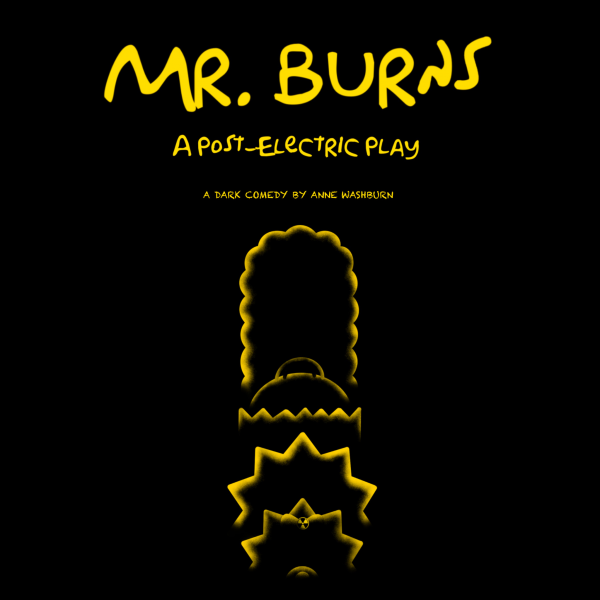
Oakland University’s School of Music, Theatre and Dance delivered an unforgettable theatrical experience with its production of “Mr. Burns, A Post-Electric Play.” Directed by Jacob Ben Widmar, the show transformed Varner Studio Theatre’s blackbox stage into a world where storytelling becomes a part of survival — and “The Simpsons” lives on as legend.
The play opens in a post-apocalyptic America, where a small group of survivors gathers around a fire, trying to piece together an old episode of “The Simpsons” from memory. What begins as a casual conversation quickly deepens into a portrait of how culture, and human connection, persist even after American society collapses.
The first act sets a serious tone as the audience begins to learn what happened to the survivors, though it is still punctuated by humor. Zander Warstler (Matt) stood out to me immediately with a natural, conversational delivery that made his scenes feel unscripted. Gavin Delorin (Sam) brought emotional nuance through his expressive acting and great line delivery. Wyatt Cleaveland (Gibson) brought authenticity to the stage, delivering his lines with a natural ease that made each moment feel lived-in.
Act II marks the production’s first major time jump — seven years into the future — and the design team made sure audiences felt it. Scenic designer Trish Brown unveiled an entirely new set, including a full apartment backdrop that was unexpectedly large for the scope of the black box theatre. This act trended toward the comedic and musical before swerving sharply into a chilling gunshot sequence. The moment was executed with precision and convincing blood effects, leaving the audience little time to process before the scene snapped to black. Brynn Cecile (Colleen) delivered an emotionally sharp performance throughout the scene, offering a commanding presence as the group’s director during the comedy sketch scenes.
By Act III, 75 years have passed, and the play reshapes itself yet again. What begins as musical theater turns into ritual — a surreal, mythic retelling of the world and the characters of “The Simpsons.” The cast’s singing was outstanding, supported by strong music direction from Laura Blanchard and live instrumentation, which was evident throughout but especially prominent in the final act.
This act belonged in particular to the performers embodying the iconic Springfield resident characters. Ian Finfrock (Mr. Burns) commanded the stage with charismatic, wicked energy, instilling an undeniable poise into the villain. Mirabella Ziegler (Lisa) was animated, expressive and difficult to look away from.
The production’s world-building was strengthened by contributions across departments: imaginative costumes by Jaci Taylor; props by Annie Eloise Findlay; hair and makeup by Cadence Potts; vibrant lighting by John Goff and Lorelei Preiss; and immersive sound design from Natalie Sevick. Together, these elements formed a post-electric world that felt both fractured and full of new life.
“Mr. Burns, a Post-Electric Play” is a story about the endurance of art — how stories reshape people, outlive them, and eventually become the myths that define a society. Oakland University’s production embraced every layer of that idea. Across its three genre-bending acts, the show was serious, funny, unsettling and at times entirely surreal, but always compelling.