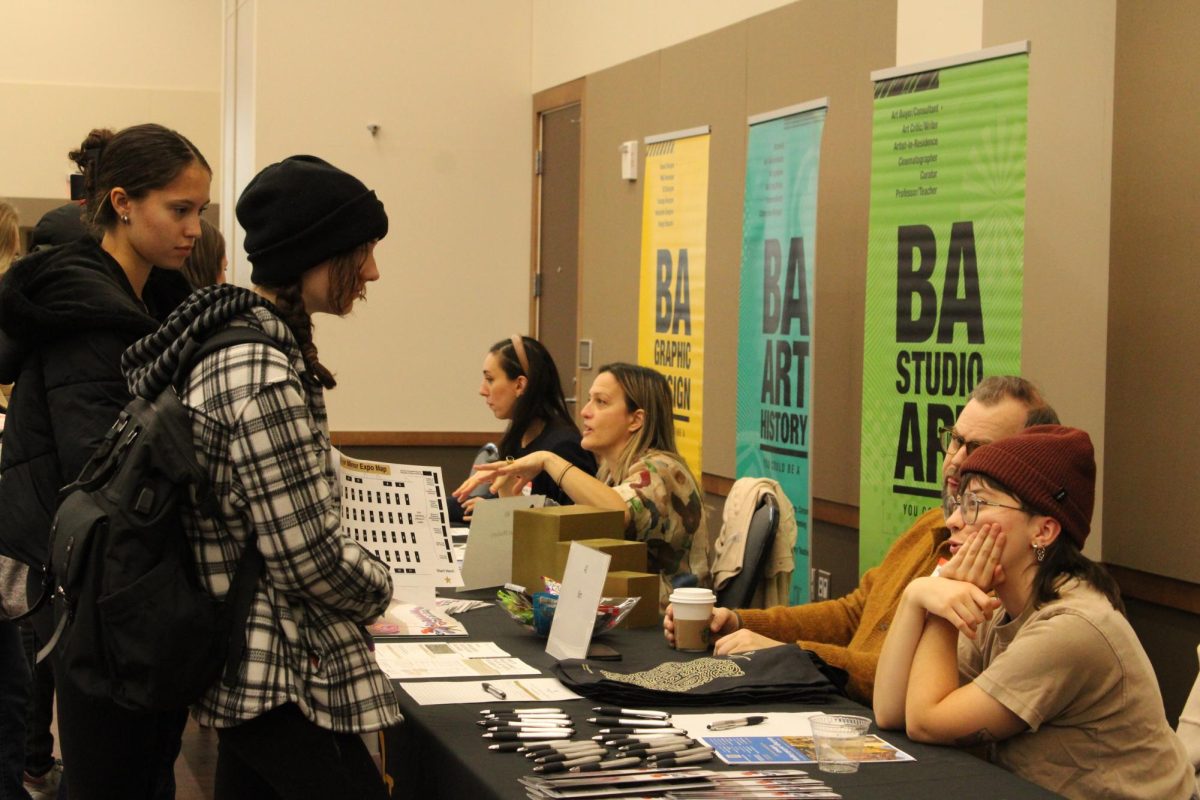
Offering over 275 degree programs, with new additions every year, Oakland University hosted the Major and Minor expo on Nov. 20, allowing students to explore, combine and gain expertise in their dream careers.
Organized by an interdisciplinary committee led by the First Year Advising Center (FYAC), the event allowed students to connect with faculty, advisers and administrators and answer inquiries about new programs, changing degrees and exploring new careers.
“I don’t know any student who comes to Oakland really, knowing all 140 majors plus all the even more minors,” Assistant Director of Advising at the FYAC Rachel Stagman said. “One of the biggest goals of this event is just to put all those opportunities in one place and make it easy for students to literally just walk around and be able to talk to the faculty, current students — the people who really know the program best.”
With all academic departments involved, the occasion also brought in employers for networking opportunities and the Career and Life Design Center to support students at any point of their college career.
Often overlooked, minors, concentrations and combined programs are offered in all departments for students to add to their area of expertise, to complement a specific discipline or to diversify their skills.
“As a minor, [creative writing] can be very useful to show that you know how to think creatively and critically, even if your majors are already set,” Katie Hartsock, associate professor of English and creative writing, said. “We have had minors who are engineers, anthropologists, who are biologists. We’ve had a wide variety of Creative Writing minors and it’s always exciting to see how they bring their realm of expertise to a poem or to a personal essay.”
The opportunities to combine disciplines go beyond the student’s curriculum, with the university supporting collaborations between departments, as Jon Carroll, associate professor of anthropology, explained.
“I’m working with the bio preserve committee, so I’m handling a lot of the archeological work that may need to be done on campus, but also in the preserve specifically,” Carroll said. He highlighted the new minor in applied geographic information science as one for the programs that allows for joint efforts between departments and students.
“It’s open to any major on campus,” Carroll said. “So if you’re into, you know, science and technology, or if you’re curious about how your phone gets you to where you want to go in the world, I teach that.”
With an increase in enrollment this year, Tom Raffel, associate professor of biological sciences, explained that years of planning go into assembling a new major after even decades of conversations. He specifically featured the new Bachelors of ecology, evolution and environmental biology, which exceeded the estimated number of enrolled students in its first year.
“I started designing this major almost eight years ago, but people have been talking about needing a major like this since before I came here 13 years ago,” Raffel said. “You can modify an old program, but it’s a little bit harder to totally change the structure. I think that’s something you can look for in new majors.”
Analysis of learning outcomes, market shares, similar programs at nearby universities and various assessments go into the years of planning a new program, Raffel said. After pulling the curtain on a new degree, professors agreed that the most important thing is to maintain communication with students who might be interested. Talking to current advisers and emailing the professors in charge of the desired program was widely recommended by professionals at the fair.
“I highly recommend that [students] try to first attend one of our information sessions because it answers a lot,” Catherine McMullen, advisor at the School of Nursing, said. “It’ll talk about all the prerequisites, the course requirements and it will help students, you know, kind of get an overall idea plus any specific questions they might have, they’ll be answered.”
Beyond majors, the university and professors have worked to streamline the transition between undergrad and master’s programs, offering combined programs like the bachelor’s and master’s in accounting (B.S./MACC) program at the School of Business. These programs allow students to save time and money to complete graduate studies.
“So you do your undergraduate in accounting and then you add, normally, one more year for the student to complete the master’s program,” Department Chair of Accounting and Finance, Liang Fu, said. “That’s going to help them get to that 150 credit hours, because to be eligible to sit for the CPA exam, you do need 150 credit hours.”
For more information, reach out to an academic adviser at oakland.edu/advising/.