


To the Oakland University Community and Our Neighbors:
We write as faculty at Oakland University, and as members of Oakland’s Native American Advisory Committee not only to alert our immediate, campus community about the university’s plans to build a data center on campus, but to alert our neighbors in Auburn Hills, Rochester Hills, Rochester, and beyond as well, who deserve transparency around this project.
The proposed location for this data center is P35, a parking lot that is next to the Native American Heritage Site, an area that was designated by President Ora Pescovitz as a Heritage Site in 2022. The Heritage Site was officially announced during a ceremony that unveiled Oakland’s new land acknowledgment, and in her speech, President Pescovitz states that the newly adopted land acknowledgement “cannot be seen as our attempt to just check a box when it comes to diversity, equity and inclusion. It must be backed up by our continued journey to advance diversity and tolerance at Oakland.
Quite simply, our acknowledgment statement must be a representation of our values. The statement references the past, but the statement must reflect our actions in the present and our commitment to honoring and acknowledging native peoples who have been historically marginalized, from American institutions, from politics, and from academia.”
Research is already revealing that data centers pose great risks to environmental and human health. Data center operations rely on both the significant intake and outflow of water for system cooling, leading to unregulated issues of resource consumption, water quality impairment, or run-off.
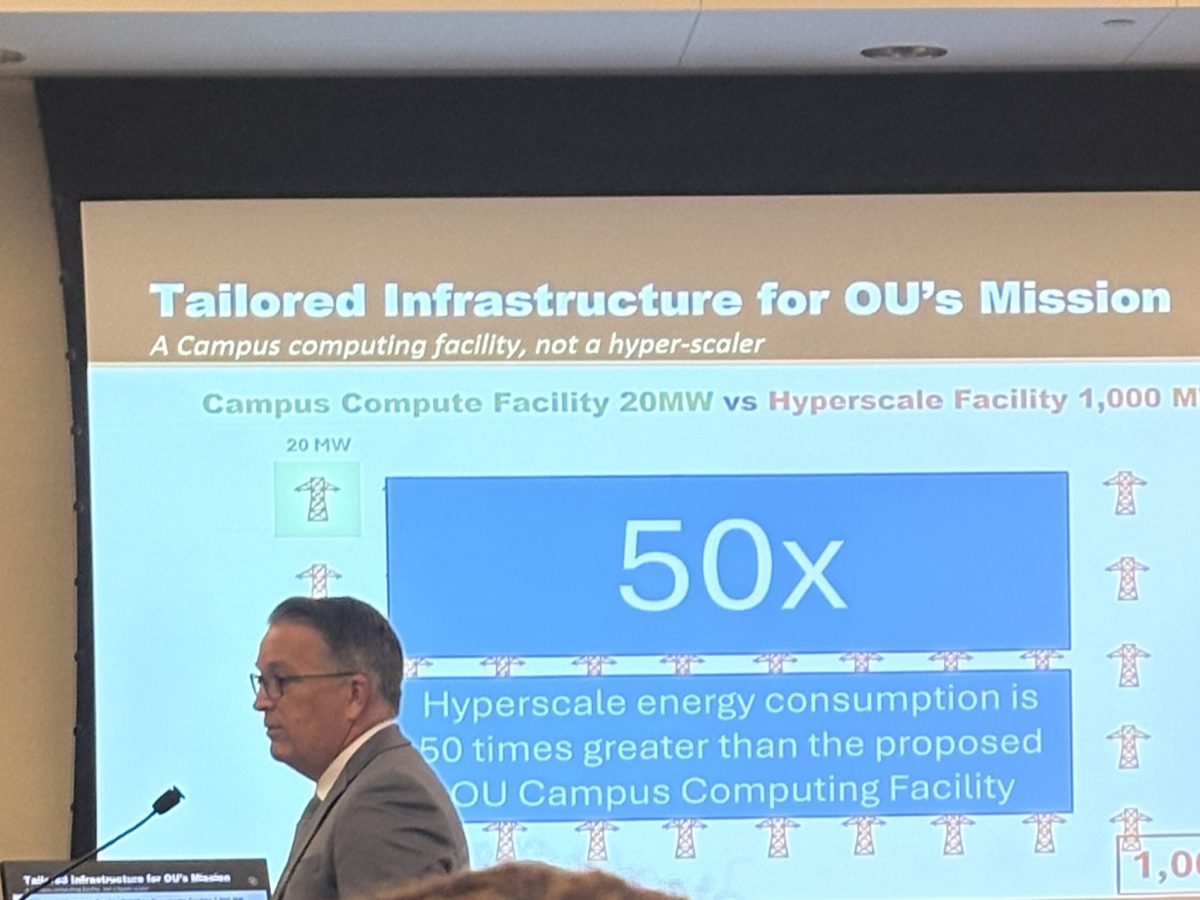
Rapid growth in direct and indirect energy consumption associated with data centers’ high energy use can put a strain on local infrastructure leading to price hikes, overload, resource prioritization issues and increased emissions. In addition, noise is the data center impact that area residents find most disturbing. Data center noise has been described as a “drone” or “hum.” The sound can be detected up to 3 miles away and can cause members of communities to suffer headaches, stress, sleep disturbances, as well as anxiety, and memory and concentration issues. Wildlife are also harmed by sound levels, which disrupt animal communication and can force new migration patterns.
Data centers are projected to contribute astronomically to electronic waste, most of which is already not managed properly and contributes to environmental contamination that disproportionately impacts low-income communities and countries.
But this data center is not only an issue that concerns Oakland University. Citizens from a variety of communities across Michigan and the U.S., from rural to suburban, to our neighbors in Rochester Hills and Auburn Hills, are concerned about the impacts of data centers on our health and environment. The data center is not only next door to the Native American Heritage Site–it is next door to you, our friends in neighboring communities.
It’s troubling that in a mere three years of having adopted a land acknowledgement and designating a Native American Heritage Site on campus that Oakland would reverse course. Power plants and chemical industries have been disproportionately located in communities of color for decades, burdening these communities with poor air quality, noxious odors, and heavy truck traffic, all of which can harm residents’ health. As energy demands soar from data centers, these same communities will bear the brunt of dirty fuels and negative health outcomes.
The environmental impact of the data center would have a substantial negative effect on the students in the Hillcrest Hall dorm, the biopreserve, and the Native American Heritage Site which is in close proximity to the proposed data center location. As Kyle Powys Whyte (Citizen Pottawatomi Nation) has noted,
Indigenous peoples in the United States experience health and culture harms from toxic environments at disproportionate rates because settler institutions pollute those environments where Native people live and work. Native students at Oakland who learn on the Native American Heritage Site deserve to do so safely. All Oakland University students, staff, faculty, and community who live, learn, and perform cultural practices on the land in the biopreserve and the surrounding area deserve to do so with sustainable, long-term safety. The plant and animal relatives who have learned over the past three years to trust the Heritage Site and to flourish in the preserve, deserve our care.
Oakland University’s stated commitment to sharing stewardship of the land with Native peoples is a responsibility for a thriving future for the land. A data center so close to the Heritage Site and biopreserve does not reflect this commitment.
Only recently did faculty even know about the Request for Proposals (RFP) that had been published by the university for the project, and we were stunned to learn that the RFP was issued on June 16th, 2025, and the sealed proposals were due for consideration by July 29, 2025. The RFP even states that the purpose for building a data center is to “introduce a diverse mix of functions and activities that align with the university’s mission, vision, and strategic priorities.”
However, this statement is contradicted by the many facts surrounding the extractive and polluting damage that data centers do to the environment and cannot be reconciled with Oakland’s claims to valuing sustainability or being stewards of place. Oakland University’s RFP states that a proposal that contains facets that are “sustainable” would be preferred, but what does that mean?
As Ben Green explains, “The AI industry is aggressively touting data centers as a boon for local economies. In response, many states—including Michigan—have passed tax breaks to incentivize data center construction. But when you look at the evidence, it’s clear that data centers are harmful for the environment and that tax breaks are a bad deal for local communities. The growth of data centers has meant that fossil fuel plants slated for closure are staying open. Meanwhile, consumers face higher energy rates. And despite the promises of bringing tech jobs, data centers provide few long-term, high-paying jobs.”
According to the University of Michigan’s Ford School report, “What Happens When Data Centers Come to Town,” evidence from existing data centers in Georgia, Illinois, Indiana, Iowa, Michigan, Nebraska, Utah, Virginia, and Washington, shows that the effects of the tax breaks benefit the corporations more than local communities.
And in an extreme move that compromises OU’s promise of “honoring and acknowledging native peoples,” the plan to build this data center next to the Native American Heritage Site is a symbolic decision that undermines any claims to respecting the worldviews, histories, and experiences of not only Native peoples but the Black and Brown communities who have suffered systems of environmental injustices for centuries.
What Oakland University seems to be forgetting, however, is that everyone will be impacted, not just Black, Brown, or Native people. This project does not only concern our campus. Oakland should be having public hearings with our neighbors.
Yet, because public universities are often exempt from zoning regulations, Oakland is not required to hold public meetings with its community or neighbors. Considering the outcry from other communities with proposed data centers, there is no meaningful dialogue if the Oakland administration continues to plan a data center without sustained, accessible, transparent, discourse with all communities involved. A “public” university should be making this a public concern.
We urge Oakland University to be transparent and accountable to our campus community and to our neighbors about their plans to build a data center. We urge the public to make their voices part of the conversation.
Sincerely,
- Megan Peiser (Choctaw Nation of Oklahoma), Department of English, Creative Writing, and Film; Co-Chair of the Native American Advisory Committee
- Keith Williams (Oneida Nation of Wisconsin), Department of Psychology
- Andrea Knutson, Department of English, Creative Writing, and Film
- Mozhgon Rajaee, Department of Public and Environmental Wellness







Shelley Stenger • Mar 23, 2026 at 12:00 PM
A concise and accurate depiction of the situation! I just found out about this last week, mid March! And it was from an outside source! Why is OU trying to hide this? Shame on administrators! And Ora, keep your promise! Matilda would NOT be happy! Let’s get the public involved! This is outrageous! STOP THIS NOW!
Andrea Wenz • Dec 11, 2025 at 9:23 AM
Bravo to my colleagues for writing this. Well said!
Ashleigh Dubie • Nov 30, 2025 at 10:34 AM
OU has a duty to its students and the larger community to prioritize people over projects like this. Ora already made commitments to these communities. She needs to see them through. Oakland University should be ashamed for this proposal, let alone if it actually is manifested.